The Material Decision That Defines Your Product Line
For OEM brands entering the pickleball paddle market, the first and most consequential decision is choosing the face material. Carbon fiber and fiberglass are the two dominant face materials in 2026, and they produce fundamentally different playing characteristics, price points, and target demographics. Get this decision wrong and you will either overpay for performance your customers do not need, or underdeliver on the expectations of your market segment.
This guide provides a complete, data-driven comparison of carbon fiber and fiberglass pickleball paddles from an OEM manufacturing perspective. We cover material science, performance differences, manufacturing processes, cost structures, and market positioning — everything you need to make an informed sourcing decision.
Understanding the Materials: What Makes Them Different
Looking for a Pickleball Paddle OEM Factory?
Browse our carbon fiber and fiberglass pickleball paddle lines, or request a custom quote.
Carbon Fiber Face
Carbon fiber is a polymer-based composite material made from thousands of individual carbon filaments (each 5–10 micrometers in diameter) woven into a fabric and bonded with epoxy resin. For pickleball paddles, the most common grades are:
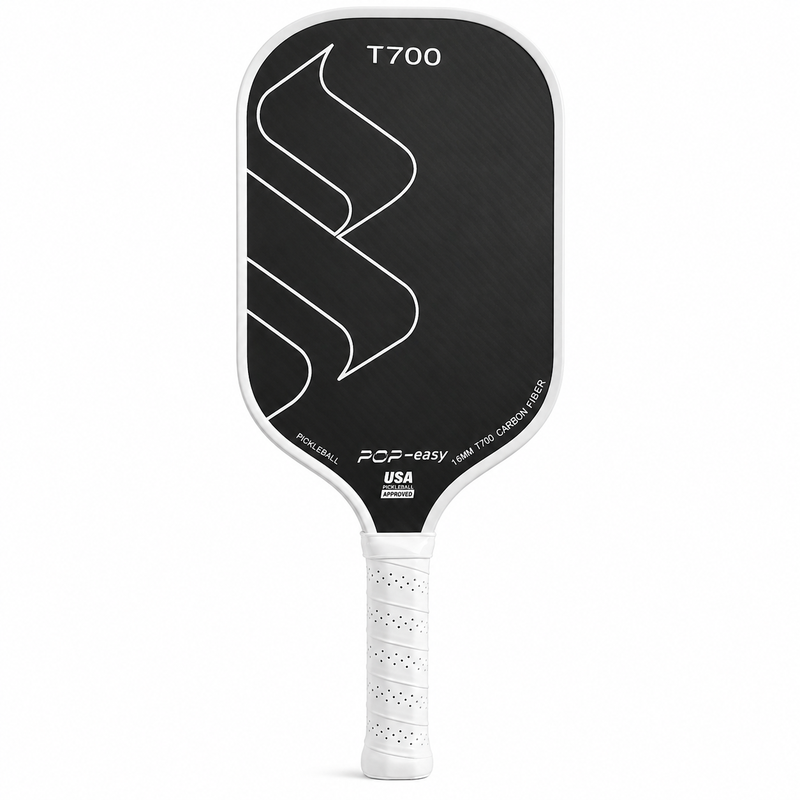
- T700 (Toray): The industry standard for premium paddles. 12K tow (12,000 filaments per bundle), tensile strength 4,900 MPa. Japanese-made Toray T700 is the most consistent and reliable source.
- T800: Higher tensile strength (5,880 MPa) but stiffer and more expensive. Used in ultra-premium paddles where maximum responsiveness is desired.
- 3K / 12K / 18K / 24K weave: Refers to the number of filaments per tow. 12K is the most popular for paddles — it balances surface texture (for spin) with structural integrity and cost.
Key property: Carbon fiber has an extremely high stiffness-to-weight ratio. A carbon fiber face is thinner and lighter than a fiberglass face of equivalent strength, which allows the paddle to have a larger sweet spot and more responsive feel without adding weight.
Fiberglass (E-Glass) Face
Fiberglass used in pickleball paddles is typically E-glass (electrical glass), a composite of fine glass fibers woven into a fabric and bonded with resin. It is the original paddle face material and remains widely used.
- Composition: Silicon dioxide (SiO₂) based fibers, typically 10–20 µm diameter
- Weave options: Plain weave, twill weave, or chopped strand mat (CSM)
- Typical thickness: 0.3–0.5 mm per layer (thicker than carbon fiber layers)
- Weight: Approximately 20–30% heavier than equivalent carbon fiber face
Key property: Fiberglass is more flexible than carbon fiber. This flexibility creates a "trampoline effect" — the face deforms more on impact, storing and releasing energy. This gives fiberglass paddles a naturally more powerful feel, but at the cost of precision and control.
Head-to-Head Performance Comparison
| Property | Carbon Fiber | Fiberglass | Winner |
|---|---|---|---|
| Weight (face only) | 15–25 g | 25–40 g | Carbon Fiber |
| Stiffness | Very High (230 GPa) | Medium (72 GPa) | Carbon Fiber |
| Power (ball pop) | High (direct energy transfer) | High (trampoline effect) | Tie (different feel) |
| Control / Touch | Excellent (stiff, predictable) | Good (flexible, less precise) | Carbon Fiber |
| Spin potential | Excellent (natural texture) | Low–Medium (smooth surface) | Carbon Fiber |
| Sweet spot size | Larger (stiffness distributes force) | Smaller (flex concentrates force) | Carbon Fiber |
| Vibration dampening | Good (with proper core pairing) | Better (natural flex absorbs) | Fiberglass |
| Durability | Excellent (no fatigue) | Good (can delaminate over time) | Carbon Fiber |
| Temperature sensitivity | Low | Medium (resin softens in heat) | Carbon Fiber |
| Face cost (per unit) | $3–8 | $0.50–2 | Fiberglass |
| Finished paddle cost | $12–30 | $5–15 | Fiberglass |
Power vs Control: The Fundamental Trade-Off
The most important performance difference between carbon fiber and fiberglass paddles is the power-control trade-off:
Carbon Fiber: Control-Oriented
Carbon fiber faces are extremely stiff. When the ball contacts the face, there is minimal deformation — the energy transfer is direct and immediate. This means:
- The ball leaves the face quickly with predictable trajectory
- Players can execute precise dinks, drops, and placement shots
- The paddle responds consistently regardless of where on the face the ball is hit
- Advanced players prefer this because they can control exactly where the ball goes
Fiberglass: Power-Oriented
Fiberglass faces flex on impact, creating a trampoline effect. The face deforms, stores elastic energy, and releases it as the ball rebounds. This means:
- The ball gets extra "pop" off the face — more power with less effort
- Beginners and recreational players find it easier to hit deep shots
- The flex absorbs some vibration, making the paddle feel softer
- The trade-off is less precision — the flex makes the ball trajectory slightly less predictable
Important nuance: The core material and thickness also significantly affect power and control. A 16mm thick-core carbon fiber paddle can feel softer and more forgiving than a 13mm thin-core fiberglass paddle. The face material is one variable in a system — but it is the most visible and marketable variable.
Spin: Carbon Fiber's Decisive Advantage
In 2026, spin has become the single most important performance differentiator in competitive pickleball. And this is where carbon fiber holds its most decisive advantage over fiberglass.
As covered in our surface texture technology guide, raw carbon fiber weave creates a naturally textured surface that generates 1,800–2,100 RPM of spin. Fiberglass faces are inherently smooth — they generate only 1,200–1,600 RPM unless grit is applied.
| Surface Type | Spin (RPM) | Spin Durability |
|---|---|---|
| Raw T700 carbon fiber | 1,800–2,100 | Permanent (life of paddle) |
| Fiberglass + applied grit | 1,800–2,200 (new) | 3–6 months (degrades 20–40%) |
| Smooth fiberglass | 1,200–1,600 | Permanent (but low) |
For OEM brands targeting the competitive or intermediate market, carbon fiber's permanent spin advantage is a powerful selling point that fiberglass cannot match without ongoing grit reapplication.
Manufacturing Process Differences
Carbon Fiber Paddle Manufacturing
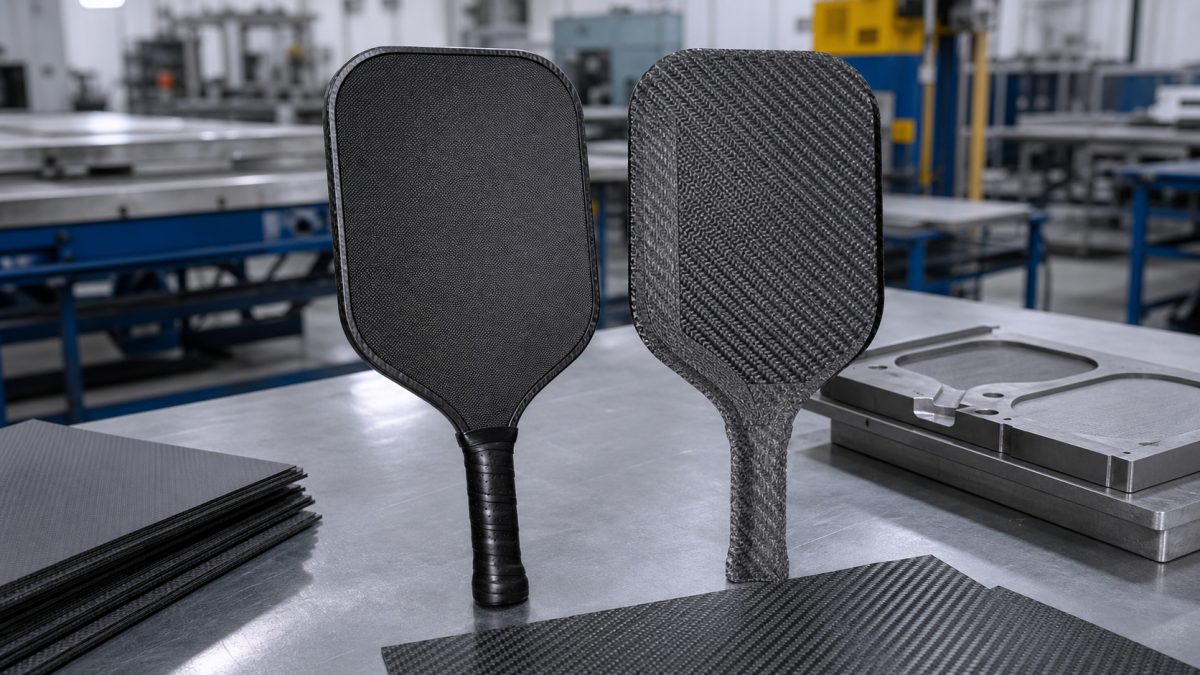
Carbon fiber paddle faces require more complex manufacturing:
- Prepreg layup: Carbon fiber fabric is pre-impregnated with resin (prepreg) and cut to shape
- Mold placement: Layers are placed in a paddle mold with the core material
- Curing: Cold-pressed (room temperature, 8–12 hours) or thermoformed (heat + pressure, 30–60 minutes)
- Trimming and finishing: Excess material trimmed, edges sealed, surface finished
Thermoformed carbon fiber paddles (Gen 2+) represent the current premium standard. The heat and pressure create a stronger bond between face and core, resulting in a more unified, responsive hitting surface. Learn more in our core technology guide.
Fiberglass Paddle Manufacturing
Fiberglass paddles are simpler and faster to produce:
- Fabric cutting: Fiberglass cloth is cut to paddle shape
- Resin application: Wet layup — resin is applied to the fabric manually or by roller
- Pressing: Cold-pressed with the core (typically PP honeycomb)
- Curing: Room temperature, 6–10 hours
- Finishing: Sanding, painting, graphic application
The simpler process means lower labor costs, faster turnaround, and lower minimum order quantities — making fiberglass ideal for promotional, recreational, and entry-level product lines.
Cost Analysis for OEM Buyers
| Cost Component | Carbon Fiber Paddle | Fiberglass Paddle |
|---|---|---|
| Face material | $3–8 per unit | $0.50–2 per unit |
| Core (PP honeycomb 16mm) | $2–4 | $2–4 |
| Edge guard + grip | $1–2 | $1–2 |
| Labor (manufacturing) | $3–6 | $2–4 |
| Surface treatment | $0 (raw carbon) or $1–3 (grit) | $0.50–2 (paint/print) |
| Total FOB cost | $12–25 | $5–14 |
| Suggested retail (US market) | $60–150 | $25–60 |
| Gross margin potential | 60–75% | 55–70% |
Key insight: While carbon fiber paddles cost 2–3x more to produce, they command 2–4x higher retail prices. The absolute profit per unit is typically higher for carbon fiber paddles, even though the percentage margin is similar.
Market Positioning Guide: Which Material for Which Segment
| Market Segment | Recommended Face | Why | Price Range |
|---|---|---|---|
| Professional / Tournament | T700 carbon fiber (thermoformed) | Maximum spin, control, and consistency | $100–200 |
| Advanced / Competitive | T700 carbon fiber (cold-pressed) | High spin, good control, better value | $70–120 |
| Intermediate | Carbon fiber or hybrid | Balanced performance, growing skill needs | $50–90 |
| Recreational / Casual | Fiberglass | Affordable, forgiving, easy to play with | $25–55 |
| Beginner / Starter Set | Fiberglass | Low cost, includes balls, low barrier to entry | $15–35 (set) |
| Promotional / Corporate | Fiberglass | Full-color printing, low MOQ, branding focus | $10–25 |
| Youth / Junior | Fiberglass | Lighter weight options, lower cost, fun graphics | $15–30 |
Hybrid Construction: The Best of Both Worlds?
Some manufacturers offer hybrid paddles that combine carbon fiber and fiberglass layers:
- Carbon fiber outer + fiberglass inner: Provides the spin and appearance of carbon fiber with the added flex and power of fiberglass. Reduces cost compared to full carbon fiber.
- Fiberglass outer + carbon fiber inner: Rare configuration. Provides a smooth printable surface with some carbon fiber stiffness. Not recommended — the fiberglass outer layer negates most carbon fiber benefits.
Hybrid construction is a viable option for mid-range product lines that want to market "carbon fiber" at a lower price point. However, for premium positioning, full T700 carbon fiber faces remain the gold standard.
Quality Control: What to Inspect
Carbon Fiber Paddles
- Weave consistency: No gaps, wrinkles, or misaligned tows in the carbon fiber fabric
- Resin content: 35–45% resin by weight. Too much resin = brittle; too little = weak
- Bond strength: Face-to-core adhesion should withstand 15+ N/cm peel force
- Surface roughness: Rz 20–25 µm for raw carbon (within USA Pickleball 30 µm limit)
- Weight consistency: ±3 g tolerance across production batch
Fiberglass Paddles
- Fabric saturation: No dry spots or resin-starved areas
- Surface smoothness: No bubbles, pinholes, or fiber protrusion
- Print adhesion: Graphics should withstand 500+ rub cycles (Taber test)
- Edge seal: Complete edge guard coverage with no gaps
- Weight consistency: ±5 g tolerance (fiberglass has more variation)
Sourcing from Global Carbon Sports
Global Carbon Sports manufactures both carbon fiber and fiberglass pickleball paddles from our Guangzhou facility:
- Premium T700 Raw Carbon Fiber Paddle Set — Japanese Toray T700, thermoformed or cold-pressed, permanent spin texture, OEM custom branding
- Wholesale T700 Carbon Fiber Paddle Set — Cost-effective T700 option with applied grit available
- Wholesale Fiberglass Paddle Set — Full-color printing, budget-friendly, ideal for recreational and promotional markets
- Complementary pickleball balls and paddle cleaning accessories
Not sure which material is right for your market? Request a free material consultation — tell us your target market, price point, and performance requirements, and we will recommend the optimal construction.
Frequently Asked Questions
Is carbon fiber always better than fiberglass for pickleball paddles?
No. Carbon fiber is better for spin, control, and durability, but fiberglass is better for affordability, vibration dampening, and beginner-friendliness. The "better" material depends entirely on your target market. For competitive players, carbon fiber is clearly superior. For recreational and promotional markets, fiberglass offers better value.
Can you make a paddle with both carbon fiber and fiberglass?
Yes, hybrid construction is possible. A carbon fiber outer layer with fiberglass inner layer provides some carbon fiber benefits (spin, appearance) at a lower cost than full carbon fiber. However, the performance will not match a full T700 carbon fiber paddle.
What is the minimum order quantity for each type?
For fiberglass paddles, MOQ starts at 100 units due to the simpler manufacturing process. For carbon fiber paddles, MOQ is typically 200–300 units due to the more complex prepreg layup and curing process. Contact us for specific MOQ based on your specifications.
How much does it cost to OEM each type?
FOB prices: fiberglass paddles $5–14 per unit, carbon fiber paddles $12–25 per unit, depending on specifications (core thickness, edge guard, grip, surface treatment, packaging). Custom branding (logo printing, custom colors) adds $0.50–2 per unit.
Which material has better warranty / return rates?
Carbon fiber paddles have lower return rates (typically 1–2%) because the material does not fatigue or delaminate under normal use. Fiberglass paddles have slightly higher return rates (3–5%) primarily due to edge guard separation and surface wear on grit-applied models. Both materials carry similar structural warranty periods (6–12 months from manufacturer).