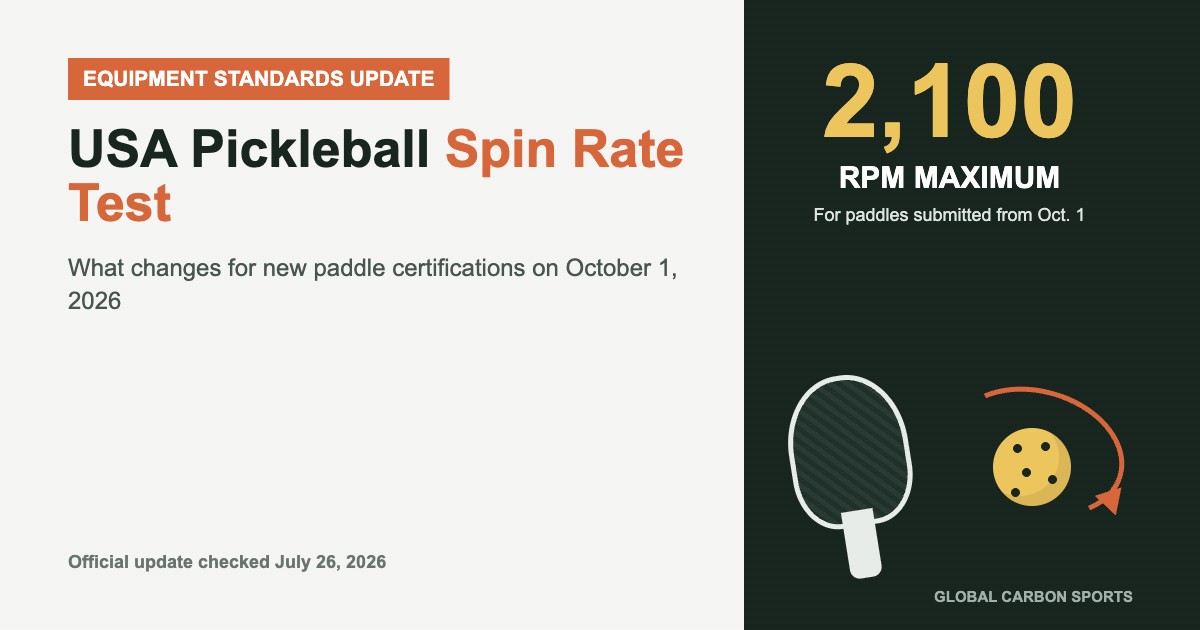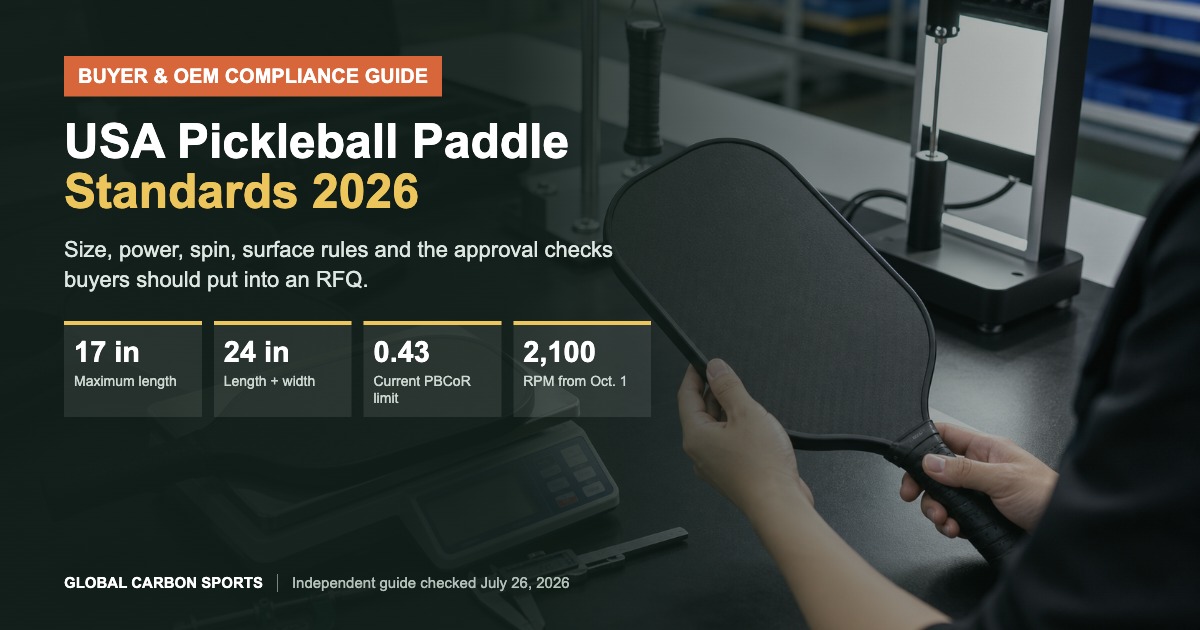
USA Pickleball paddle standards in one answer: a paddle may be no longer than 17 inches, and its combined length plus width, including the edge guard and butt cap, may not exceed 24 inches. The published rules set no maximum weight or thickness. The paddle must be rigid, non-compressible and free of prohibited performance-enhancing features. The current published PBCoR power limit is 0.43. For paddles submitted from October 1, 2026, USA Pickleball has announced a maximum measured spin rate of 2,100 RPM. A model is legal for sanctioned play only when the exact brand and model is listed as Pass in the official Approved Paddle List.
This guide was checked on July 26, 2026. USA Pickleball's publicly linked Equipment Standards Manual is Revision 3.0 from January 2025, while a July 2026 official update changes the spin-testing framework from October 1. Buyers must read the manual together with later official notices.
USA Pickleball paddle standards at a glance
| Area | Published requirement or status | OEM buyer action |
|---|---|---|
| Maximum length | 17 in / 43.18 cm | Measure the complete paddle, not only the face. |
| Length + width | Maximum 24 in / 60.96 cm, including edge guard and butt cap | Put both finished dimensions and tolerance on the drawing. |
| Thickness | No published maximum | Specify the commercial target; “no rule maximum” is not a manufacturing tolerance. |
| Weight | No published maximum | Define target, range and balance point for player fit and production consistency. |
| Power | PBCoR not to exceed 0.43 from November 1, 2025 | Request model-specific evidence and change control for core and construction. |
| Spin from Oct. 1, 2026 | New certification submissions must measure 2,100 RPM or less | Freeze the face process and obtain evidence before locking the submission sample. |
| Surface transition | Current roughness and friction limits remain available through Sept. 30; afterward their upper thresholds become measurements of record | Do not mix the January 2025 manual values with the post-Oct. 1 framework. |
| Approval status | Exact brand and model must appear as Pass in the official database | Verify the live list before printing approval claims or shipping tournament inventory. |
Which document is current in 2026?
Looking for a Pickleball Paddle OEM Factory?
Browse our carbon fiber and fiberglass pickleball paddle lines, or request a custom quote.
The official rules page currently links to the 2025 Equipment Standards Manual, Revision 3.0. That manual remains the primary published specification document, but it is not the whole 2026 picture. USA Pickleball's July 8, 2026 equipment notice adds a dated transition for spin testing. Where a later official notice changes an implementation date or threshold, buyers should use the later notice and confirm the current submission instructions directly with USA Pickleball.
Open the current official Equipment Standards Manual PDF on USA Pickleball's website. We link to the association's copy instead of hosting a mirror because the manual expressly prohibits dissemination, publication or copying without written consent. This also avoids serving an old copy after USA Pickleball updates the source file.
Size, thickness and weight rules
How is the 24-inch combined limit calculated?
Add the paddle's overall length to its maximum width. The total must be 24 inches or less, and length alone must be 17 inches or less. The edge guard and butt cap count. A 16.5-inch-long paddle, for example, has at most 7.5 inches remaining in the combined dimension budget. This is why elongated paddles are normally narrower than widebody models.
Are thick or heavy paddles automatically illegal?
No. The published standard states no restriction on paddle thickness or weight. That does not mean either specification can be uncontrolled. Thickness changes can affect core behavior, power and model identity; weight and balance affect handling and production consistency. Put finished tolerances in the RFQ and treat significant construction changes as a certification question.
Use our paddle shape guide, weight and balance guide and grip and handle guide to turn these regulatory boundaries into a complete commercial specification.
Surface, texture and reflectivity
The hitting surface must not use holes, indentations, rough texturing or added features that create excessive spin. The January 2025 manual also sets a maximum reflectivity reading of 80 gloss units (GU) for the hitting surface and edge guard when measured at 60 degrees.
During the current transition, the January 2025 manual lists average surface-roughness ceilings of 30 micrometers Rz and 40 micrometers Rt, individual-point ceilings of 33 Rz and 44 Rt, and a maximum kinetic coefficient of friction of 0.1875. USA Pickleball's July 2026 notice says that from October 1 the upper thresholds for surface roughness and coefficient of friction will be replaced by measurements of record, while the 2,100 RPM spin test becomes the direct limit for new submissions. Those two sources must not be quoted as if they describe the same implementation date.
For material and process implications, see our paddle surface and spin technology guide and the separate 2,100 RPM implementation guide.
Power control: what does PBCoR 0.43 mean?
PBCoR means Paddle/Ball Coefficient of Restitution. It is a controlled test used to characterize how much rebound performance the paddle-ball system produces. The January 2025 manual announced a not-to-exceed limit of 0.44 from November 1, 2024 and 0.43 from November 1, 2025. As of this article's verification date, 0.43 is the current published threshold.
For an OEM program, PBCoR is not simply a face-material number. Core material, thickness, layup, bonding, cure and any break-in or degradation behavior can affect the finished model. USA Pickleball states that production paddles must remain identical to the certified paddle and compliant over their useful life, including changes that improve performance through break-in or degradation.
Prohibited features and allowed player alterations
| Generally prohibited by the published manual | Examples of permitted alterations, if the finished paddle still complies |
|---|---|
| Anti-skid or textured paint using sand, rubber, vinyl or similar spin-enhancing compounds | Edge-guard tape or replacement |
| Rubber or synthetic-rubber hitting surfaces and sandpaper-like characteristics | Weighted tape or weights for an OEM integrated weight system |
| Springs, flexible membranes or compressible materials creating a trampoline effect | Grip inserts, wraps, OEM interchangeable grips and OEM replacement faces |
| Moving parts that increase head momentum, and electrical, electronic or mechanical assistance | Name decals and limited identification markings that do not change surface roughness |
Permitted does not mean unlimited. The complete altered paddle still has to satisfy every applicable specification, and the manual restricts where tape, decals and markings may extend. Buyers designing an integrated weight system or replaceable component should confirm the exact certification treatment before tooling.
Brand, model and Approved Paddle List requirements
- The paddle must clearly show the manufacturer brand and model name or model number.
- Different core material, surface material or other significant differences require a unique model name or number.
- Do not print or advertise “USA Pickleball Approved” before testing is complete and the exact model appears in the public database.
- Approval is model-specific. A similar construction, prototype, unreleased edition or related SKU is not automatically covered.
- USA Pickleball approval is an equipment status for sanctioned play, not a general endorsement of the company or every product claim.
Check the live USA Pickleball Approved Equipment database before artwork approval, shipment and tournament use.
What should an OEM buyer put in the RFQ?
- Exact model identity: brand, model designation, intended approval pathway and planned submission date.
- Finished geometry: overall length, maximum width, thickness, edge guard, butt cap and tolerances.
- Mass properties: target weight range, balance point and any integrated weight system.
- Controlled construction: face material and finish, core, adhesive, layup, cure and approved golden sample.
- Performance evidence: model-specific PBCoR and applicable spin/surface records, with test method and sample identity.
- Change control: written approval and re-evaluation trigger for supplier, material, tooling or process changes.
- Production traceability: lot code, inspection record, retained sample and link between mass production and the certified model.
- Marketing release gate: approval wording and seal may be released only after the live database confirms Pass.
Download the independent 2026 OEM buyer checklist
Download the USA Pickleball Paddle Standards 2026 OEM Buyer Checklist (PDF)
This original checklist condenses the purchasing actions in this article into a printable review sheet. It is an independent Global Carbon Sports resource, not an official USA Pickleball publication, certification, legal opinion or substitute for the current rules.
1. Source and timing check
- Open the official manual from USA Pickleball, not a third-party mirror.
- Record the manual revision and the date the official notices were checked.
- Confirm which requirements apply on the planned certification submission date.
2. Product specification check
- Overall length ≤17 in; length + width ≤24 in, including edge guard and butt cap.
- Finished thickness, weight range and balance point are documented even though no rule maximum is published.
- Brand and unique model designation match the intended submission sample.
3. Performance and construction check
- PBCoR evidence is model-specific and compared with the current published 0.43 ceiling.
- For submissions from Oct. 1, 2026, measured spin is ≤2,100 RPM.
- Surface, reflectivity, prohibited-feature and alteration requirements have been reviewed.
- Face, core, adhesive, layup and cure are frozen to an approved golden sample.
4. Approval and production check
- The exact model appears as Pass in the live Approved Paddle List before approval claims are printed.
- Each production lot is traceable and kept consistent with the certified construction.
- Material, supplier, tooling or process changes trigger written review and re-evaluation when needed.
Checked July 26, 2026. Always verify the latest official sources: Equipment Standards Manual, Approved Equipment database, and 2026 Spin Rate Test update.
Official sources and scope
- USA Pickleball Equipment Standards Manual, Revision 3.0 (January 2025)
- USA Pickleball Spin Rate Test update (July 8, 2026)
- USA Pickleball Approved Equipment database
Independent interpretation last checked July 26, 2026. USA Pickleball controls the rules, testing protocols and approval decisions. Global Carbon Sports does not represent that every product it offers is approved; approval must be verified for the exact model in the official database.
Frequently asked questions
What is the maximum legal pickleball paddle size?
Maximum length is 17 inches. Overall length plus maximum width, including the edge guard and butt cap, must be 24 inches or less.
Is there a maximum paddle thickness or weight?
The published USA Pickleball standard states no restriction on thickness or weight. Manufacturers still need controlled commercial tolerances, and construction changes may affect other compliance tests.
Is every paddle from an approved manufacturer legal?
No. Approval is tied to the exact brand and model listed as Pass. Check the live database rather than relying only on packaging or a supplier statement.
Why is the official manual not hosted on this website?
The official manual expressly prohibits copying or distribution without written consent. Direct linking also ensures buyers reach USA Pickleball's latest source file. Our downloadable checklist is original, independently written and clearly labeled non-official.
Can an OEM factory guarantee USA Pickleball approval?
No. A factory can control specifications, samples, traceability and supporting test evidence, but USA Pickleball makes the certification decision.