The Grip Is Where the Player Touches the Product
OEM buyers invest heavily in face material, core technology, and surface texture — and rightly so. But the one component the player holds for every single point of every single match is the grip. A paddle with a perfect T700 face and a thermoformed core will still get returned if the grip circumference is wrong for the target player’s hand, or if the handle length does not match their swing mechanics. Grip specification is the most personal, most felt, and most frequently mismatched element in pickleball paddle design.
This guide gives OEM buyers the complete technical picture: grip circumference standards, how players measure their size, handle length and its effect on two-handed play, grip shape and overgrip strategy, and how grip choices interact with the weight and balance decisions covered in our weight and balance guide.
Grip Circumference: The Core Specification
Looking for a Pickleball Paddle OEM Factory?
Browse our carbon fiber and fiberglass pickleball paddle lines, or request a custom quote.
Pickleball grip size is measured as the circumference of the grip (the distance around the handle where the hand holds it), expressed in inches. The market has consolidated around two dominant sizes, with two smaller niche sizes:
| Grip Size | Circumference | Approx. mm | Typical Player | Market Share (US) |
|---|---|---|---|---|
| Small | 4 in | ~102 mm | Youth, players with small hands, some women | ~5% |
| Standard Small | 4 1/8 in | ~105 mm | Most women, players with average-small hands | ~35% |
| Standard Large | 4 1/4 in | ~108 mm | Most men, players with average-large hands | ~45% |
| Large | 4 3/8 in | ~111 mm | Players with large hands, some tennis converts | ~10% |
| Extra Large | 4 1/2 in | ~114 mm | Very large hands (rare) | ~5% |
Important note: Pickleball grip sizing (inches of circumference) is a different system from badminton grip sizing (G4, G5, G6 in millimeters of circumference). Do not confuse the two when specifying across product lines. Our badminton grip size guide covers the G-system separately.
How Players Determine Their Grip Size
Retail buyers and end players use two common methods. OEM brands should understand both because they drive which sizes sell:
The Index Finger Test
The player holds the paddle with their dominant hand using a continental grip (like shaking hands with the paddle). With the opposite hand, they slide the index finger into the gap between the fingertips and the palm of the gripping hand. If the index finger fits snugly in the gap, the grip size is correct. Too much room means the grip is too large; no room means it is too small.
The Ruler Measurement
The player opens their dominant hand and measures from the middle crease of the palm (the top horizontal crease) to the tip of the ring finger. That length in inches equals the recommended grip circumference:
- Measurement under 4 in → grip size 4 in
- Measurement 4 to 4 1/8 in → grip size 4 1/8 in
- Measurement 4 1/4 to 4 3/8 in → grip size 4 1/4 in
- Measurement over 4 3/8 in → grip size 4 3/8 in or 4 1/2 in
OEM implication: Because most players can adjust one size up by adding an overgrip (see below) but cannot easily go smaller, the safer default stock size for an unknown market is 4 1/8 in. A player with a 4 1/4 in preference can add a thin overgrip to a 4 1/8 in handle, but a player needing 4 1/8 in cannot comfortably shrink a 4 1/4 in handle. This is why many brands stock 4 1/8 in as the base and offer 4 1/4 in as the secondary option.
The Overgrip Factor: Why Base Size Matters
An overgrip is a thin wrap (typically 0.5–0.7 mm thick) applied over the existing grip to refresh tackiness, absorb sweat, or slightly increase circumference. Each overgrip layer adds approximately 1.5–2 mm to the grip circumference (roughly 1/16 in). This means:
- A 4 1/8 in base grip + one overgrip ≈ 4 1/4 in feel
- A 4 1/8 in base grip + two overgrips ≈ 4 3/8 in feel
- A 4 in base grip + one overgrip ≈ 4 1/8 in feel
This is the single most important reason to stock smaller base sizes: players can always build up, but they cannot build down. For OEM lines targeting competitive players (who change overgrips frequently for fresh tack), a 4 1/8 in base is ideal because it leaves room to add their preferred overgrip without exceeding their target size.
Handle Length: The Overlooked Performance Lever
Handle length is measured from the bottom of the grip (butt cap) to the point where the handle meets the paddle face. It typically ranges from 4.5 in to 5.5 in (114–140 mm), and it has a major effect on play style that most buyers overlook.
| Handle Length | Range | Effect on Play | Best For |
|---|---|---|---|
| Short | 4.5–4.75 in | More face length within the 17 in limit, higher sweet spot, less leverage | Singles, players who want maximum face, one-handed play |
| Standard | 4.75–5.0 in | Balanced leverage and face size | Most players, all-around play |
| Long | 5.0–5.5 in | More leverage on serves and drives, room for two-handed backhand, slightly lower sweet spot | Tennis converts, two-handed backhand players, power players |
The 17-Inch Rule and the Face/Handle Trade-Off
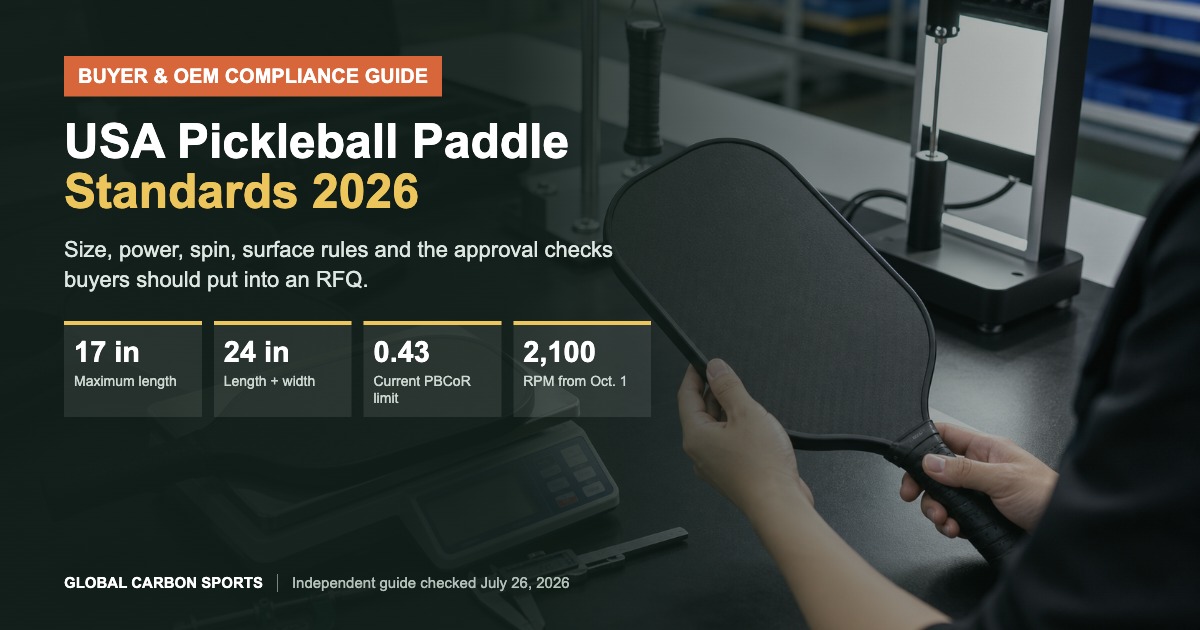
USA Pickleball rules limit the combined length plus width to 24 in and the length to a maximum of 17 in. Because the total length is capped at 17 in, every millimeter added to the handle is a millimeter removed from the face. This creates a direct trade-off:
- Longer handle (5.25–5.5 in): Better for two-handed backhands and leverage, but the face is shorter, raising the sweet spot and slightly reducing the hitting area.
- Shorter handle (4.5–4.75 in): Maximizes face length and lowers the sweet spot toward the center, but leaves no room for a two-handed backhand grip.
Market trend 2026: As pickleball attracts more tennis and table-tennis converts who rely on a two-handed backhand, demand for longer handles (5.25 in and above) is growing fast. OEM lines aimed at the competitive and tennis-convert segments should offer a long-handle SKU alongside the standard handle.
Grip Shape: Round vs Contoured vs Octagonal
Beyond circumference, the cross-sectional shape of the grip affects feel and orientation feedback:
- Round / cushion: A smooth oval cross-section. Most common in pickleball. Comfortable, no pressure points, but gives less tactile feedback on grip orientation (players cannot feel which way the face is pointing without looking).
- Contoured: Slight ridges molded into the grip that align with the fingers. Provides orientation feedback and a locked-in feel. Popular with competitive players.
- Octagonal: Eight flat bevels, borrowed from tennis. Gives the strongest orientation feedback. Less common in pickleball but preferred by some tennis converts.
For OEM specification, round/cushion is the safe universal default; contoured is a premium upgrade for competitive lines.
Grip Material and Construction
| Component | Options | OEM Notes |
|---|---|---|
| Inner grip (replacement grip) | Polyurethane (PU) foam, 1.5–2.0 mm | Defines base circumference and cushion. PU density affects shock absorption. |
| Surface tack | Tacky (sticky) vs dry (absorbent) | Tacky for dry climates / control feel; dry/absorbent for humid climates / sweaty hands. |
| Perforation | Perforated vs solid | Perforated improves moisture wicking; preferred in hot/humid markets. |
| Butt cap | Flared vs straight, with logo insert | Flared cap prevents the paddle slipping out; logo insert is a branding opportunity. |
How Grip Interacts with Weight and Balance
The grip and handle are not isolated from the weight and balance decisions in our weight and balance guide. They interact in two ways:
- Handle length shifts the balance point: A longer handle moves mass toward the hand, making the paddle feel more head-light and maneuverable even at the same total weight. A short handle pushes the balance toward the head.
- Grip weight adds to total weight: A thick cushioned grip plus two overgrips can add 8–15 g. When targeting a precise total weight (for example 7.8 oz), the grip specification must be factored into the weight budget alongside the face and core.
OEM Specification Checklist
- Base grip circumference: Specify in inches (4, 4 1/8, 4 1/4, 4 3/8, 4 1/2). Stock 4 1/8 in as default.
- Handle length: Specify in inches or mm. Offer standard (4.75–5.0 in) plus a long-handle SKU (5.25–5.5 in) for competitive/tennis-convert lines.
- Grip shape: Round/cushion (default) or contoured (premium).
- Inner grip material and thickness: PU foam, 1.5–2.0 mm, specify density.
- Surface tack and perforation: Match to target climate/market.
- Butt cap: Flared, with custom logo insert.
- Overgrip inclusion: Decide whether to bundle a spare overgrip (a low-cost, high-perceived-value addition).
- Size tolerance: ±1 mm on circumference for premium lines.
Market Positioning by Grip Configuration
| Segment | Base Grip | Handle Length | Shape |
|---|---|---|---|
| Professional / competitive | 4 1/8 in (room for overgrip) | 5.0–5.25 in | Contoured |
| Tennis convert | 4 1/4 in | 5.25–5.5 in (long) | Octagonal or contoured |
| Intermediate / all-around | 4 1/8 in + 4 1/4 in | 4.75–5.0 in | Round/cushion |
| Women / small hands | 4 in + 4 1/8 in | 4.75 in | Round/cushion |
| Youth / junior | 3 7/8 in + 4 in | 4.5 in | Round/cushion |
| Promotional | 4 1/8 in (single universal) | 4.75 in | Round/cushion |
Sourcing from Global Carbon Sports
Global Carbon Sports offers full grip and handle customization across all paddle lines from our Guangzhou facility:
- Premium T700 Carbon Fiber Paddles — Grip sizes 4 to 4 3/8 in, handle lengths 4.75–5.5 in, contoured or round grip, custom logo butt cap
- Wholesale T700 Carbon Fiber Paddles — Standard 4 1/8 in and 4 1/4 in grips, standard and long handles
- Fiberglass Paddles — Universal 4 1/8 in grip, customizable on request
- Complementary pickleball balls and paddle accessories
Not sure which grip and handle configuration fits your market? Request a grip and handle consultation — tell us your target player, hand-size profile, and play style.
Frequently Asked Questions
What is the most popular pickleball paddle grip size?
The two most popular sizes are 4 1/8 in and 4 1/4 in, together covering roughly 80% of the US market. For an OEM line where you can only stock one base size, 4 1/8 in is the safer default because players can add an overgrip to size up, but cannot size down.
Should I stock multiple grip sizes or just one?
For premium and retail lines, stock at least two sizes (4 1/8 in and 4 1/4 in) to cover the majority of players. For promotional or budget lines, a single universal 4 1/8 in grip keeps SKU count and inventory cost low. Competitive lines should also offer a 4 in option for players with smaller hands.
How does handle length affect a two-handed backhand?
A two-handed backhand requires room on the handle for the non-dominant hand above the dominant hand. Handles of 5.0 in and longer comfortably accommodate two hands; handles under 4.75 in force the player into a one-handed backhand or a cramped two-handed grip. If your target market includes tennis converts, offer a long-handle (5.25–5.5 in) SKU.
Does adding an overgrip change the official grip size?
Yes. Each overgrip adds roughly 1.5–2 mm (about 1/16 in) to the circumference. A 4 1/8 in base grip with one overgrip feels close to 4 1/4 in. This is why competitive players who change overgrips often prefer a smaller base size — it leaves headroom for their overgrip of choice.
What grip circumference tolerance should I specify for OEM orders?
For premium and competitive lines, specify ±1 mm on grip circumference and verify with a flexible measuring tape on pre-production samples. For standard retail lines, ±2 mm is acceptable. Grip size consistency matters because players who reorder the same model expect the same feel.