Surface Texture Is the New Battleground
In 2026, the most heated competition in pickleball paddle design is not about core material or paddle shape — it is about the hitting surface. Surface texture directly determines how much spin a player can generate, and spin has become the single most impactful skill differentiator in competitive pickleball. For OEM brands sourcing paddles from Chinese manufacturers, understanding surface texture technology is now as critical as understanding core construction.
The surface is where the ball meets the paddle. The friction coefficient between ball and face determines how much rotational energy transfers during the brief 3–5 millisecond contact window. More friction means more spin potential — but only within the boundaries set by USA Pickleball regulations.
This guide covers every surface texture option available to OEM buyers, the science behind spin generation, current regulatory limits, and how to specify the right surface treatment for your market.
USA Pickleball Surface Regulations: What Is Legal
Looking for a Pickleball Paddle OEM Factory?
Browse our carbon fiber and fiberglass pickleball paddle lines, or request a custom quote.
Before selecting a surface treatment, every OEM buyer must understand the regulatory framework. USA Pickleball sets strict limits on paddle surface roughness to prevent excessive spin that would make the game unplayable:
| Parameter | Limit | Measurement Method |
|---|---|---|
| Surface Roughness (Rz) | ≤ 30 µm (micrometers) | Profilometer, average maximum height peak-to-valley |
| Surface Roughness (Rt) | ≤ 40 µm | Profilometer, maximum peak-to-valley |
| Surface Texture | No sandpaper-like surfaces | Visual and tactile inspection |
| Holes/Indentations | Not permitted on hitting surface | Visual inspection |
| Reflectivity | Must not be reflective enough to distract opponents | Visual inspection |
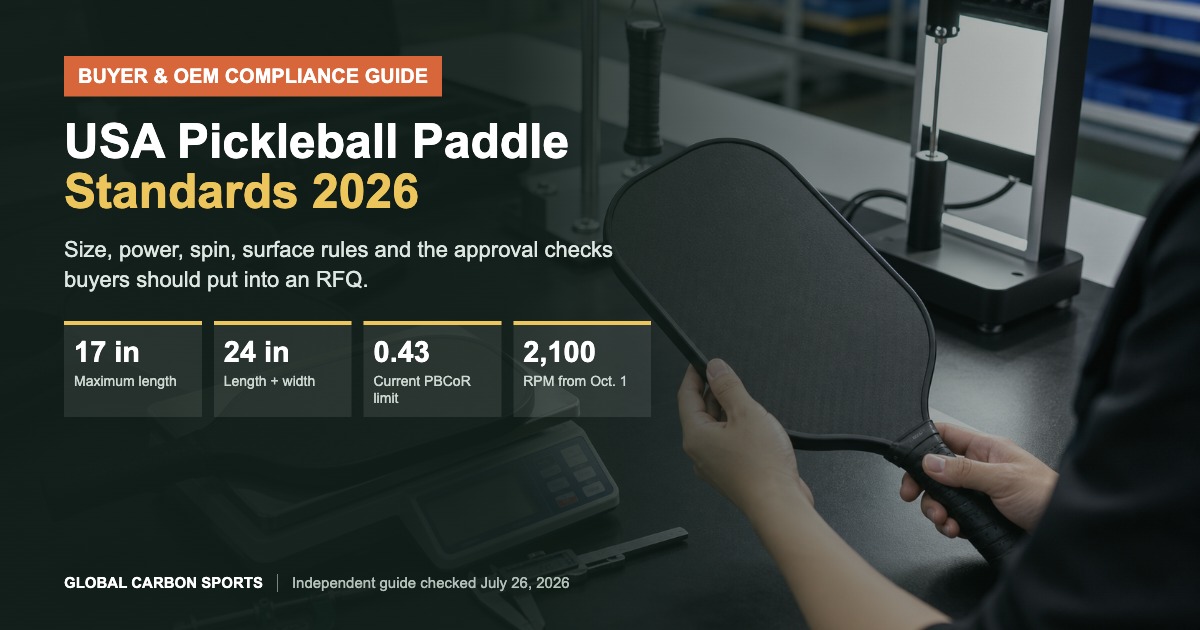
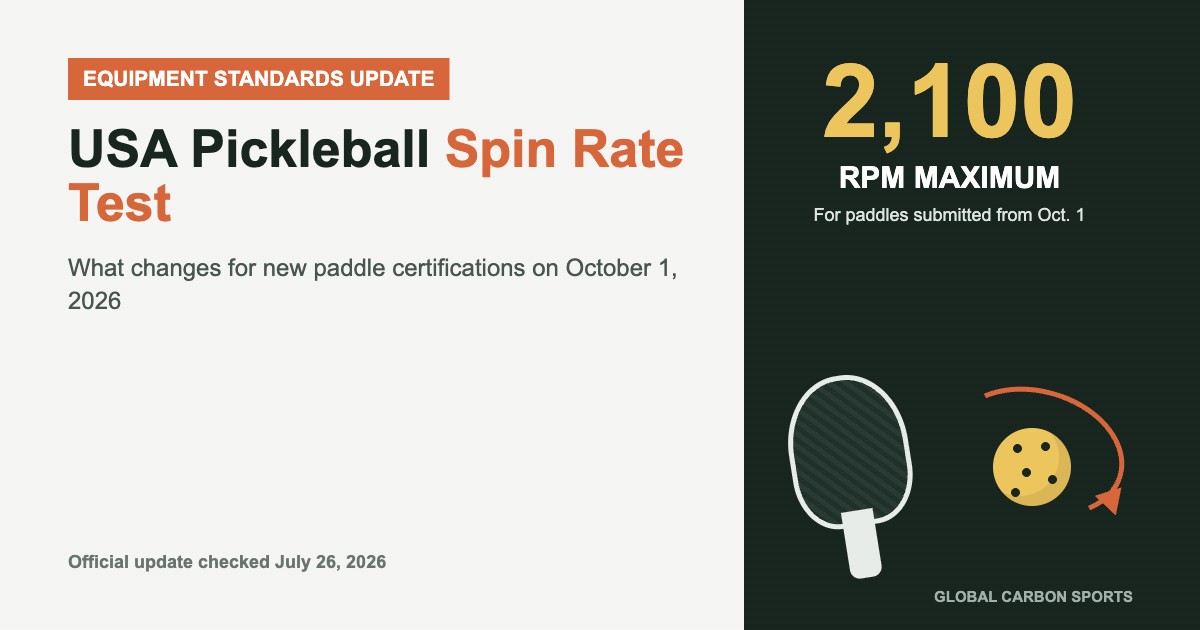
Important 2026 Update: Starting October 1, 2026, newly certified paddles must also pass a direct spin test measuring actual ball rotation. The proposed limit is approximately 2,100 RPM. This shifts the evaluation from surface roughness alone to actual spin performance — meaning a paddle can have a rough surface but still pass if it does not generate excessive spin, or a smooth surface could theoretically fail if the material creates high friction through other mechanisms.
The Three Surface Texture Categories
1. Raw Carbon Fiber Surface (Natural Grit)
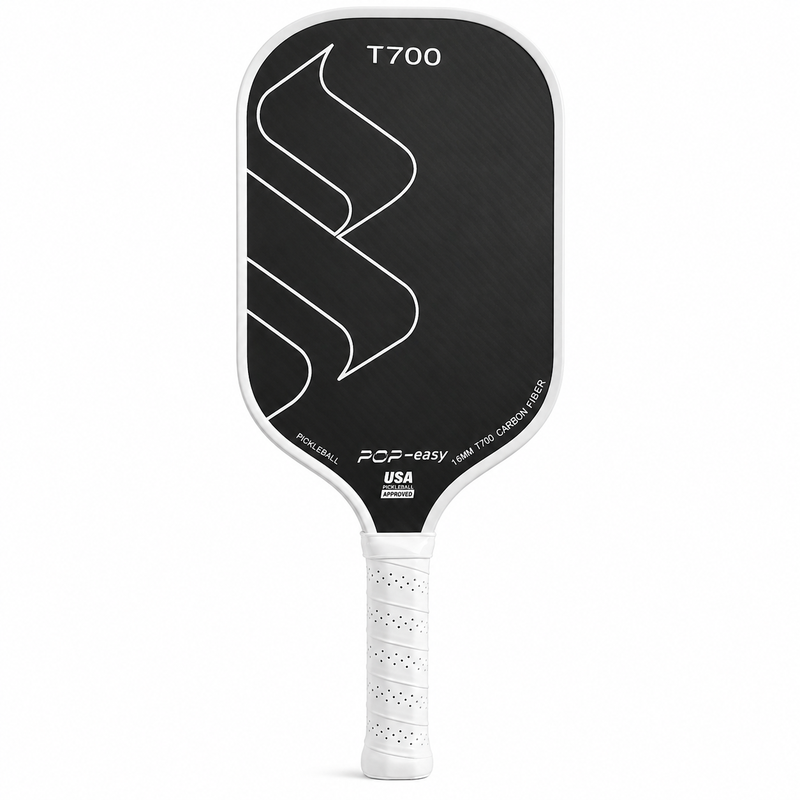
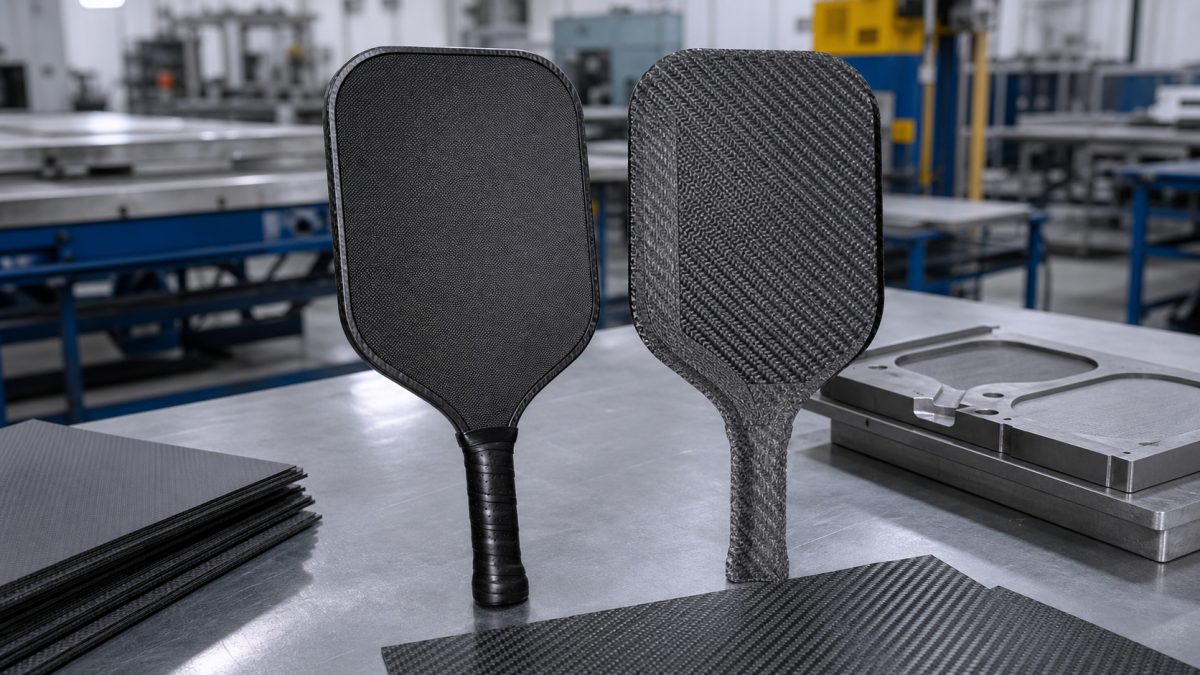
The most popular premium surface in 2025–2026. Instead of applying a coating, the paddle face uses exposed T700 or T800 carbon fiber weave as the hitting surface. The natural texture of the carbon fiber tow (individual fiber bundles) creates a microscopically rough surface that grips the ball.
How it works: T700 carbon fiber has a distinctive plain or twill weave pattern. Each fiber tow is approximately 6–7 mm wide and contains 12,000 individual filaments. The surface between and across the tows creates natural micro-channels and ridges that increase the friction coefficient with the pickleball surface.
Key characteristics:
- Natural, permanent texture: Unlike applied grit that wears off, the carbon fiber weave is structural — the texture lasts the entire life of the paddle
- Consistent spin: The weave pattern provides uniform friction across the entire face
- Premium appearance: The exposed carbon fiber weave has a distinctive, high-end visual that buyers associate with quality
- Spin performance: Generates 1,800–2,100 RPM on typical shots, near the regulatory ceiling
- Best paired with: Thermoformed construction (Gen 2+) for maximum performance
OEM consideration: The quality of the carbon fiber weave matters enormously. Toray T700 from Japan produces the most consistent, durable weave. Cheaper carbon fiber from unknown sources may have inconsistent tow spacing, resin pooling, or surface voids that affect both appearance and spin performance.
Our premium T700 raw carbon fiber paddles use Japanese Toray T700 with a controlled plain weave for optimal spin and appearance.
2. Applied Grit Surface (Coated Texture)
The traditional approach to adding spin: embedding abrasive particles into the paddle surface coating. The most common grit materials are:
- Silicon carbide (SiC): The hardest and most aggressive grit. Creates maximum initial spin but wears fastest. Grit size typically 80–120 grit (125–180 µm particle size).
- Aluminum oxide (Al₂O₃): Slightly less aggressive than SiC but more durable. Good balance of spin and lifespan. Grit size typically 100–150 grit.
- Proprietary blends: Some manufacturers use custom mixtures of ceramic, mineral, or polymer particles optimized for specific spin-durability profiles.
Application methods:
- Spray coating: Grit particles are mixed into a resin or paint and sprayed onto the face. Most common and cost-effective.
- Screen printing: Grit-loaded ink is screen-printed in a pattern. Allows zone-specific texture (rougher in the center, smoother at edges).
- Film lamination: A pre-manufactured grit film is laminated onto the face. Most consistent but highest cost.
Key characteristics:
- High initial spin: Fresh grit surfaces can generate 2,000+ RPM
- Wear concern: Grit particles gradually wear down with use. Spin performance degrades 20–40% over 3–6 months of regular play
- Customizable: Grit type, size, density, and pattern can all be tuned for specific performance targets
- Cost-effective: Applied grit is significantly cheaper than raw carbon fiber faces
- Can be applied to any face: Works on fiberglass, carbon fiber, or composite faces
3. Smooth / Composite Surface
The original pickleball paddle surface: a smooth painted or clear-coated face with no intentional texture. Still used in recreational and budget paddles.
Key characteristics:
- Lowest spin: Smooth surfaces generate 1,200–1,600 RPM — significantly less than textured surfaces
- Most durable: No grit to wear off, no weave to degrade. The surface looks the same after years of play
- Most affordable: Simple paint or clear coat application
- Best for beginners: Lower spin makes the ball more predictable, easier to learn with
- Easy to customize visually: Smooth surfaces accept full-color printing, graphics, and branding easily
Surface Texture Comparison Table
| Property | Raw Carbon Fiber | Applied Grit | Smooth/Composite |
|---|---|---|---|
| Spin (RPM) | 1,800–2,100 | 1,800–2,200 (new) | 1,200–1,600 |
| Spin durability | Excellent (permanent) | Poor (degrades 20–40%) | Excellent (no change) |
| Surface lifespan | Life of paddle | 3–6 months peak | Life of paddle |
| Cost impact | High (T700 face) | Low–Medium | Lowest |
| Appearance | Premium carbon weave | Matte/sandy texture | Glossy, printable |
| Regulatory risk | Low (within limits) | Medium (new grit may exceed) | None |
| Best for | Premium, competitive | Mid-range, spin-focused | Recreational, beginner |
The Science of Spin: Why Texture Matters
When a paddle strikes a pickleball at an angle, the friction between the two surfaces converts some of the linear kinetic energy into rotational energy. The amount of spin generated depends on:
- Friction coefficient: Higher friction = more energy transfer to rotation. Surface texture increases the effective friction coefficient by creating mechanical interlocking between the paddle surface and the ball surface.
- Contact time (dwell time): Longer contact = more time for friction to act. Softer cores (16mm+) increase dwell time, which is why thick-core paddles with textured surfaces generate the most spin.
- Attack angle: The angle between the paddle face and the ball trajectory at contact. More extreme angles (low-to-high for topspin) generate more spin regardless of surface.
- Ball surface: The pickleball itself has a textured surface (the holes create edges). The interaction between paddle texture and ball texture is what creates the friction.
Important nuance: Research shows that higher surface roughness does not always equal higher friction. The relationship is complex and depends on the specific materials, contact pressure, and surface geometry. A well-engineered raw carbon fiber surface can outperform a rougher applied grit surface because the carbon fiber creates a more consistent, directional friction pattern.
Grit Durability: The #1 Buyer Complaint
For OEM brands selling paddles with applied grit surfaces, durability is the most common customer complaint and return reason. Here is what happens over time:
- Games 1–20: Peak spin performance. Grit particles are sharp and fully exposed.
- Games 20–50: Grit particles begin to round and flatten. Spin drops 10–15%.
- Games 50–100: Significant grit loss in high-contact zones (center of face). Spin drops 20–30%.
- Games 100+: Grit largely worn away in the sweet spot area. Spin approaches smooth-surface levels.
Solutions for OEM buyers:
- Use harder grit: Silicon carbide lasts longer than aluminum oxide but is more aggressive initially
- Increase grit density: More particles per square centimeter extends effective lifespan
- Use larger particles: 80-grit lasts longer than 120-grit but may approach regulatory limits
- Switch to raw carbon fiber: The permanent solution — texture never wears off
OEM Specification Guide
When ordering paddles with specific surface treatments, include these specifications in your RFQ:
For Raw Carbon Fiber Surface
- Carbon fiber grade: T700 (standard) or T800 (premium)
- Weave pattern: Plain weave (most common, balanced spin) or twill weave (softer appearance)
- Tow size: 12K (standard) or 3K (finer texture, more spin)
- Surface finish: Matte (more grip) or semi-gloss (easier to clean)
- Resin system: Epoxy (standard) or toughened epoxy (more durable)
For Applied Grit Surface
- Grit material: Silicon carbide, aluminum oxide, or proprietary blend
- Grit size: 80, 100, 120, or 150 grit
- Application method: Spray, screen print, or film lamination
- Coverage: Full face or zone-specific
- Base coat color: Black (most common), gray, or custom
- Target Rz: Specify within 15–30 µm range
For Smooth Surface
- Finish type: Glossy, matte, or satin
- Print method: Water transfer, UV printing, or decal
- Clear coat: UV-resistant polyurethane recommended
- Color: Full Pantone customization available
Market Preferences by Region
| Market | Preferred Surface | Reason |
|---|---|---|
| USA (competitive) | Raw carbon fiber | Maximum spin, premium positioning |
| USA (recreational) | Applied grit or smooth | Cost-effective, good enough spin |
| Europe | Raw carbon fiber or smooth | Premium brands prefer carbon; recreational prefers smooth |
| Latin America | Applied grit | Price-sensitive, spin-focused |
| Asia-Pacific | Raw carbon fiber | Premium market, brand-conscious |
| Middle East | Applied grit or carbon | Growing market, mixed preferences |
Quality Control for Surface Texture
When inspecting incoming paddle shipments, verify these surface quality points:
- Roughness measurement: Use a profilometer to measure Rz and Rt at 5 points across the face. All readings must be within USA Pickleball limits (Rz ≤ 30 µm, Rt ≤ 40 µm).
- Visual inspection: Check for resin pooling, voids, uneven weave (carbon fiber), or inconsistent grit distribution (applied grit).
- Adhesion test: For applied grit, perform a cross-hatch tape test (ASTM D3359) — rating must be 4B or better.
- Spin consistency: If possible, test 3 sample paddles on a spin measurement device. RPM variance between paddles should be ≤ 5%.
- Appearance: Carbon fiber weave should be symmetrical, aligned, and free of wrinkles. Grit coating should be uniform with no bare spots.
Sourcing from Global Carbon Sports
Global Carbon Sports offers all three surface texture options from our Guangzhou facility:
- T700 raw carbon fiber surface paddles — Japanese Toray T700, plain weave, permanent spin texture, thermoformed construction
- T700 carbon fiber with applied grit option — Custom grit specification available
- Fiberglass smooth surface paddles — Full-color printing, budget-friendly, ideal for recreational and promotional markets
- Complementary pickleball balls and paddle cleaning accessories
Request a surface texture consultation — tell us your target market, spin requirements, and budget, and we will recommend the optimal surface treatment.
Frequently Asked Questions
Does raw carbon fiber really provide more spin than applied grit?
In initial performance, high-quality applied grit can match or slightly exceed raw carbon fiber spin (2,000+ RPM vs 1,800–2,100 RPM). However, applied grit degrades 20–40% over 3–6 months, while raw carbon fiber maintains its spin for the entire life of the paddle. Over the paddle lifespan, raw carbon fiber delivers more total spin.
Can you add grit to a raw carbon fiber paddle?
Technically yes, but it is not recommended. The grit coating obscures the carbon fiber appearance (eliminating the premium visual), and the grit will still wear off while the carbon fiber texture underneath remains. It is better to choose one approach.
What is the best surface for a beginner paddle line?
Smooth composite surface with full-color printing. Beginners do not benefit from high spin (it makes the ball harder to control), and smooth surfaces are the most affordable, most durable, and easiest to brand with custom graphics.
How do I ensure my paddles pass USA Pickleball surface testing?
Specify a target Rz of 20–25 µm (well within the 30 µm limit) in your RFQ. Request pre-production samples with profilometer test reports. For applied grit, avoid grit sizes coarser than 80 grit. For raw carbon fiber, standard T700 plain weave naturally falls within limits.
What is the new 2026 spin test and how does it affect OEM orders?
Starting October 1, 2026, USA Pickleball will require newly certified paddles to pass a direct spin measurement test (approximately 2,100 RPM limit). This means surface roughness alone is no longer sufficient — the actual spin output matters. Paddles already certified before this date are grandfathered. For new OEM orders targeting the US market, we recommend testing spin output on pre-production samples.