The Core Is the Paddle
Ask any experienced pickleball player what matters most in a paddle, and the answer is rarely the face material or the grip — it is the core. The core determines how the paddle feels on contact, how much power it generates, how large the sweet spot is, how much vibration reaches the player hand, and how the paddle performs across the full range of shots from dinks to drives.
For OEM brands and distributors sourcing pickleball paddles from Chinese manufacturers, understanding core technology is essential. It is the primary differentiator between a $15 recreational paddle and a $200+ tournament paddle. It is also the area where the most rapid innovation is occurring — the industry has moved through four distinct core generations in roughly five years, with each generation solving specific performance limitations of the previous one.
This guide covers every core generation, every major core material, and every thickness option so you can specify the right paddle construction for your target market.
Core Materials: The Building Blocks
Looking for a Pickleball Paddle OEM Factory?
Browse our carbon fiber and fiberglass pickleball paddle lines, or request a custom quote.
Before diving into generations, let us understand the four primary core materials used in pickleball paddles:
1. Polymer (Polypropylene / PP) Honeycomb
The most widely used core material in modern pickleball paddles. PP honeycomb consists of a hexagonal cell structure (similar to aerospace composite panels) that provides an excellent balance of:
- Lightweight: Typical density 3–6 lb/ft³, keeping paddle weight in the 7.3–8.4 oz range
- Rigidity: The hexagonal cell structure resists compression while remaining lightweight
- Vibration damping: The air-filled cells absorb impact vibration, reducing arm fatigue
- Consistent feel: Uniform cell structure provides predictable response across the face
- Cost-effective: PP honeycomb is the most economical high-performance core option
Cell size matters: smaller cells (4mm–6mm) create a denser, firmer feel with more power; larger cells (8mm–12mm) create a softer, more forgiving feel with better control. Most OEM paddles use 6mm or 8mm cell sizes.
2. Nomex (Aramid Fiber) Honeycomb
Nomex honeycomb uses aramid fiber cells instead of polypropylene. Originally developed for aerospace applications, Nomex cores are:
- Harder and denser: Creates a firmer, more powerful response with a distinctive "pop" sound
- Heavier: Adds 0.3–0.5 oz compared to equivalent PP honeycomb
- More durable: Aramid fiber resists compression set (permanent deformation) better than PP
- Louder: The harder surface creates more audible impact — some players love it, some do not
- Less forgiving: Smaller sweet spot due to the rigid, less-damping structure
Nomex cores are popular in power-oriented paddles and were dominant in early competitive pickleball before PP honeycomb became the standard.
3. Aluminum Honeycomb
Aluminum honeycomb cores are the lightest option, used primarily in ultra-light paddles (under 7.3 oz). Characteristics:
- Lightest weight: Enables paddles as light as 6.8–7.2 oz
- Excellent touch: Very soft, responsive feel ideal for dinking and soft game
- Less power: The lightweight structure does not generate as much ball speed on drives
- Prone to denting: Aluminum cells can permanently deform under hard impact
- Niche application: Primarily for players with arm injuries or those prioritizing touch over power
4. EVA / EPP Foam
Foam cores (ethylene-vinyl acetate or expanded polypropylene) represent the newest core technology:
- Softest feel: Maximum vibration damping, very quiet impact
- Most forgiving: Foam compresses uniformly, creating the largest effective sweet spot
- Heavier: Solid foam is denser than honeycomb, adding weight
- Less power: Energy is absorbed by foam compression rather than returned to the ball
- Best for control: Ideal for players who prioritize placement and soft game
Core Material Comparison Table
| Property | PP Honeycomb | Nomex Honeycomb | Aluminum Honeycomb | EVA/EPP Foam |
|---|---|---|---|---|
| Weight impact | Low (lightest honeycomb) | Medium | Very low | Medium-high |
| Power | Balanced | High | Low | Low-medium |
| Control | Balanced | Medium | High | Very high |
| Sweet spot size | Medium-large | Medium | Medium | Very large |
| Vibration damping | Good | Poor | Good | Excellent |
| Durability | Good | Excellent | Fair (dents) | Good |
| Sound | Moderate | Loud "pop" | Quiet | Very quiet |
| Cost | $$ | $$$ | $$$ | $$ |
| Best for | All-around, most players | Power players | Touch / lightweight | Control / soft game |
The Four Generations of Pickleball Paddle Core Construction
Core material is only half the story. How the core is assembled into the paddle structure defines the generation. Here is the evolution:
Gen 1: Cold-Pressed Honeycomb (2019–2021)
Construction: A flat sheet of PP (or Nomex) honeycomb is cut to the paddle shape. Face sheets (fiberglass, carbon fiber, or graphite) are bonded to the top and bottom of the honeycomb using adhesive film. The entire assembly is pressed in a cold mold (room temperature or slightly heated) under hydraulic pressure to cure the adhesive.
Edge treatment: The exposed honeycomb edge is covered with an edge guard (plastic or composite strip) glued around the perimeter.
Characteristics:
- Good control and spin (especially with raw carbon fiber face)
- Smaller sweet spot — the flat honeycomb flexes more at the edges
- Noticeable vibration on off-center hits
- Edge guard adds weight and creates a slight dead zone along the perimeter
- Most affordable construction method
OEM relevance: Gen 1 is still the most common construction for mid-range and recreational paddles. It is the baseline from which all improvements are measured. Our cold-pressed fiberglass paddle set uses this proven construction.
Gen 1.5: Cold-Pressed + Foam Edge Injection (2021–2022)
Construction: Same cold-pressed honeycomb core as Gen 1, but with a critical addition: polyurethane foam is injected into the perimeter cells of the honeycomb before the face sheets are bonded. This fills the outer 8–12 mm of honeycomb cells with foam.
Characteristics:
- Reduced vibration on off-center hits (foam dampens edge oscillation)
- Slightly larger effective sweet spot (foam-reinforced edges flex less)
- More solid feel on edge shots
- Minimal weight increase (+0.1–0.2 oz from foam)
- Still uses an edge guard
OEM relevance: Gen 1.5 is a cost-effective upgrade from Gen 1 that noticeably improves feel. The foam injection step adds minimal production cost but significantly improves player perception of quality.
Gen 2: Thermoformed Unibody (2022–2024)
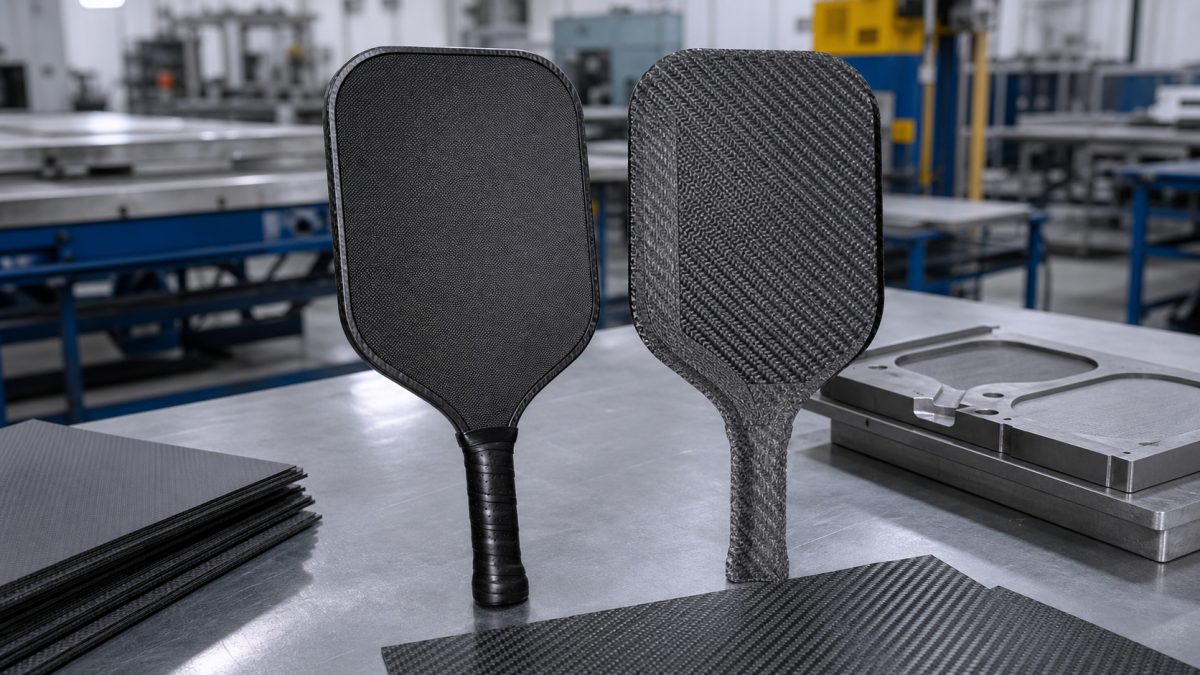
Construction: This is the biggest leap in paddle technology. Instead of bonding flat face sheets to a honeycomb slab, the entire paddle is thermoformed as a single unit:
- The honeycomb core is placed in a heated mold (150–200°C)
- Pre-impregnated carbon fiber or fiberglass face sheets are laid over the core
- The mold closes under high pressure (50–100 tons)
- Heat activates the resin in the face sheets, which flows into and around the honeycomb cells
- The face material wraps around the core edges, creating a continuous surface from face to edge — no separate edge guard needed
- The result is a single, fused structure where the face, core, and edge are one integrated unit
Characteristics:
- Increased rigidity: The thermoformed bond is stronger and more uniform than cold-pressed adhesive
- Larger sweet spot: The wrapped edge creates a continuous hitting surface with no dead zone at the perimeter
- Balanced power and control: The rigid unibody transfers energy efficiently while the honeycomb still provides feel
- No edge guard: The wrapped construction eliminates the separate edge guard, saving 0.2–0.4 oz
- Better consistency: Thermoforming produces more uniform paddle-to-paddle quality than cold pressing
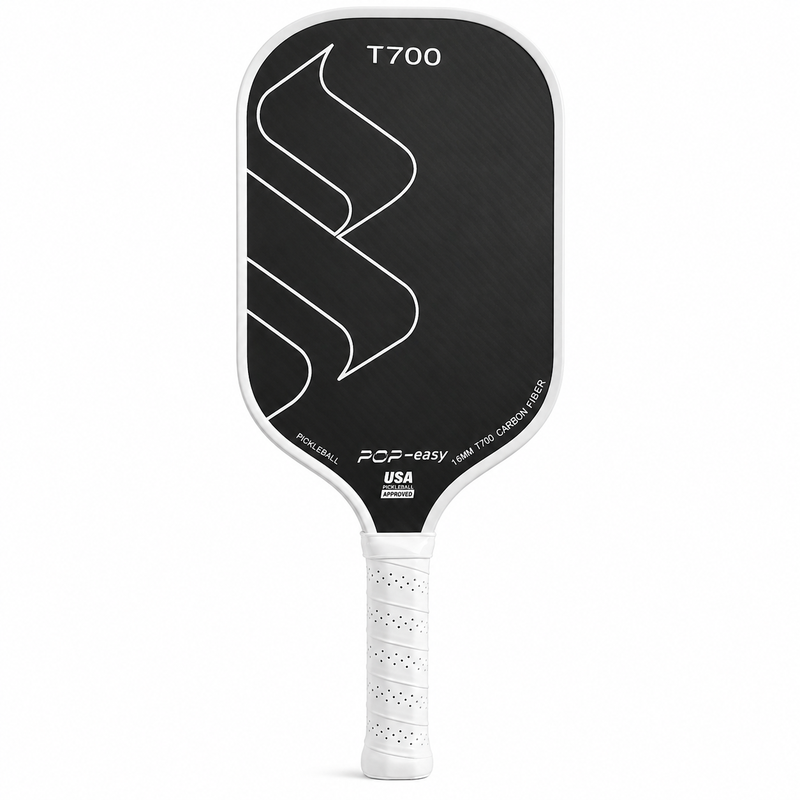
OEM relevance: Gen 2 thermoformed is the current standard for mid-to-premium paddles. Our T700 raw carbon fiber paddle and premium T700 OEM set use thermoformed construction with Japanese T700 carbon fiber face sheets.
Gen 3: Thermoformed + Compressed Foam Perimeter (2024–2025)
Construction: Builds on Gen 2 thermoforming but adds a compressed foam perimeter ring (typically EVA or PU foam) around the outer edge of the honeycomb core before thermoforming. During the heat-press cycle, the foam compresses and fuses with the honeycomb and face sheets.
Characteristics:
- Maximum power: The foam perimeter creates a "trampoline effect" — the edge zone flexes and rebounds, adding ball speed on drives
- Largest sweet spot: The foam-reinforced perimeter extends the effective hitting area to the very edge of the paddle
- Reduced vibration: Foam perimeter absorbs off-center impact energy
- Slightly heavier: Foam adds 0.2–0.3 oz compared to Gen 2
- Premium pricing: The additional foam step and tighter process control increase manufacturing cost
OEM relevance: Gen 3 is the current premium tier. It is what most $150–$250 retail paddles use. For OEM brands positioning in the premium segment, Gen 3 construction is the minimum expectation.
Gen 3.5: Hybrid Honeycomb + Foam Perimeter (2025)
Construction: A refinement of Gen 3 that uses PP honeycomb in the center and foam in the perimeter, but with a more gradual transition zone. The honeycomb cells in the transition area are partially filled with foam, creating a gradient from rigid center to flexible edge.
Characteristics:
- Balanced feel: Combines the crisp center response of honeycomb with the forgiving edge of foam
- Wider performance window: Performs well across all shot types (dinks, drives, blocks, resets)
- Player-friendly: The gradient construction is more forgiving of inconsistent contact points
Gen 4: Full Foam Core (2025–2026)
Construction: Eliminates the honeycomb entirely. The core is a solid EPP (expanded polypropylene) or EVA foam block, shaped to the paddle profile and thermoformed with carbon fiber or fiberglass face sheets.
Characteristics:
- Softest feel: Maximum vibration damping — virtually zero hand shock
- Quietest: Foam absorbs impact sound, producing a muted "thud" instead of a "pop"
- Most forgiving: Uniform foam compression creates the largest sweet spot of any generation
- Less power: Foam absorbs more energy than honeycomb, reducing ball speed on drives
- Heavier: Solid foam is denser than honeycomb, typically adding 0.3–0.5 oz
- Best for: Players with arm/elbow issues, control-oriented players, and beginners
OEM relevance: Gen 4 is still emerging. It is finding a niche in the therapeutic/comfort segment and among senior players. Not yet the mainstream choice for competitive paddles.
Generation Comparison Table
| Feature | Gen 1 | Gen 1.5 | Gen 2 | Gen 3 | Gen 3.5 | Gen 4 |
|---|---|---|---|---|---|---|
| Core structure | Flat honeycomb | Honeycomb + foam edge | Thermoformed unibody | Thermo + foam perimeter | Hybrid honeycomb/foam | Full foam |
| Face bonding | Cold press adhesive | Cold press adhesive | Heat-fused (thermoform) | Heat-fused | Heat-fused | Heat-fused |
| Edge treatment | Edge guard | Edge guard | Wrapped (no guard) | Wrapped + foam | Wrapped + foam | Wrapped |
| Sweet spot | Medium | Medium-large | Large | Very large | Very large | Largest |
| Power | Medium | Medium | Medium-high | High | Medium-high | Medium-low |
| Control | Good | Good | Very good | Good | Very good | Excellent |
| Vibration | Noticeable | Reduced | Low | Very low | Very low | Minimal |
| Weight | Lightest | Light | Light | Medium | Medium | Heaviest |
| Manufacturing cost | $ | $ | $$ | $$$ | $$$ | $$ |
| Retail price tier | $40–$80 | $60–$100 | $100–$160 | $150–$250 | $150–$220 | $100–$180 |
Core Thickness: The Overlooked Specification
Core thickness is as important as core material and generation, yet many OEM buyers overlook it. Thickness directly affects the paddle power-control balance:
| Thickness | Power | Control | Feel | Best For |
|---|---|---|---|---|
| 13 mm | Maximum | Lower | Crisp, firm, responsive | Power players, aggressive baseliners |
| 14 mm | High | Good | Balanced, slightly firm | All-court players who want extra pop |
| 16 mm | Balanced | Very good | Soft, forgiving, dwell time | Most players — the industry standard |
| 19–20 mm | Lower | Maximum | Very soft, maximum dwell | Control specialists, dink-heavy players |
Why thickness matters: A thinner core (13mm) has less material to compress, so more energy is returned to the ball — resulting in more power but less dwell time (the ball leaves the face faster, giving the player less time to impart spin or direction). A thicker core (16mm+) compresses more, absorbing energy but giving the player a longer dwell window for control and spin.
The 16mm standard: Approximately 70% of paddles sold in 2025–2026 use a 16mm core. It is the safest default for OEM orders targeting the general market. If your brand serves advanced players, consider offering 14mm (power) and 16mm (control) variants.
Face Material Interaction with Core
The core does not work in isolation — the face material significantly affects how the core performs:
- Raw carbon fiber (T700/T800): The stiffest face material. Maximizes energy transfer from core to ball. Best paired with 14–16mm PP honeycomb for a balanced power-control profile. Our T700 raw carbon fiber paddles use this combination.
- Fiberglass: More flexible than carbon fiber, creating a natural trampoline effect. Pairs well with thinner cores (13–14mm) for maximum power, or thicker cores (16mm) for a unique flex-and-control feel. See our fiberglass paddle line.
- Graphite: Lightweight and stiff, but less durable than carbon fiber. Common in mid-range paddles.
- Hybrid faces: Carbon fiber + fiberglass weave combines stiffness with flex. An emerging trend for Gen 3/3.5 paddles.
OEM Specification Checklist
When requesting quotes for pickleball paddles, specify these core parameters:
- Core material: PP honeycomb (specify cell size: 4mm, 6mm, or 8mm), Nomex, aluminum, or foam
- Core thickness: 13mm, 14mm, 16mm, or 19–20mm
- Generation: Gen 1 (cold press), Gen 2 (thermoformed), Gen 3 (thermo + foam perimeter), or Gen 4 (full foam)
- Face material: T700/T800 raw carbon fiber, fiberglass, graphite, or hybrid
- Edge treatment: Edge guard (Gen 1/1.5) or wrapped thermoformed edge (Gen 2+)
- Target weight: 7.3–8.4 oz (specify range)
- Grip size: 4" (standard) or 4.25" (large) circumference
- Surface texture: Smooth, grit-coated, or raw carbon fiber texture (affects spin)
What is Next: Emerging Core Technologies
The pickleball paddle industry is innovating rapidly. Technologies to watch:
- Variable-density honeycomb: Different cell sizes in different zones of the paddle (smaller cells in the center for power, larger cells at the edges for forgiveness)
- Graphene-infused foam: Adding graphene particles to EPP foam to increase energy return without adding weight
- 3D-printed lattice cores: Custom lattice geometries optimized by FEA (finite element analysis) for specific performance profiles
- Thermoplastic honeycomb: New PP formulations that allow thermoforming at lower temperatures, reducing energy cost and enabling more complex geometries
Sourcing from Global Carbon Sports
Global Carbon Sports manufactures pickleball paddles across all core generations from our Guangzhou facility:
- Gen 1/1.5 cold-pressed fiberglass paddles — MOQ 100, ideal for recreational and mid-range markets
- Gen 2 thermoformed T700 carbon fiber paddles — 16mm PP honeycomb core, Japanese T700 face
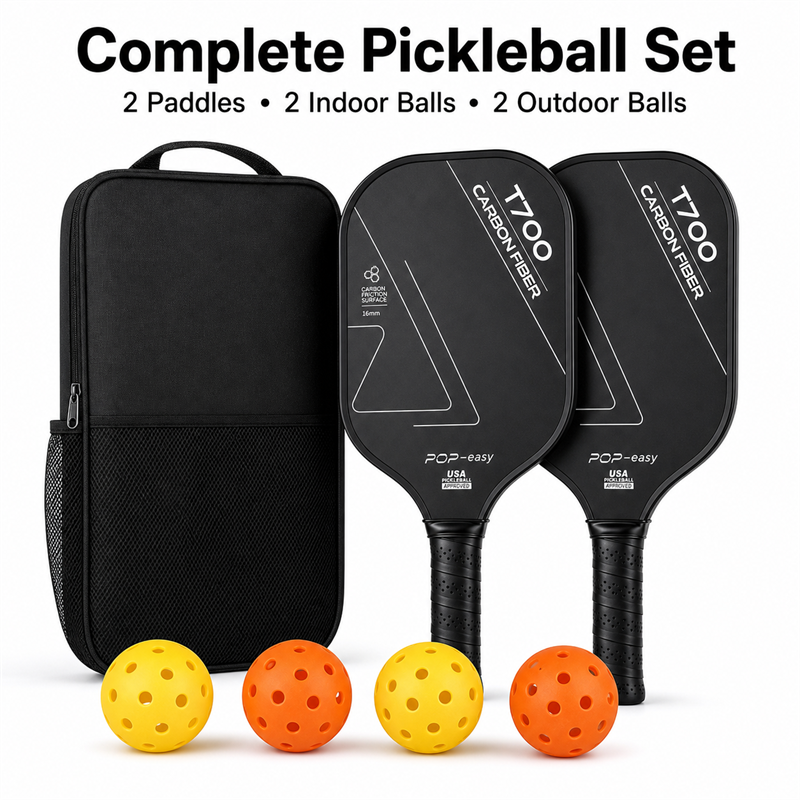
- Premium T700 OEM paddle sets — Full custom specification including core thickness, face material, and surface treatment
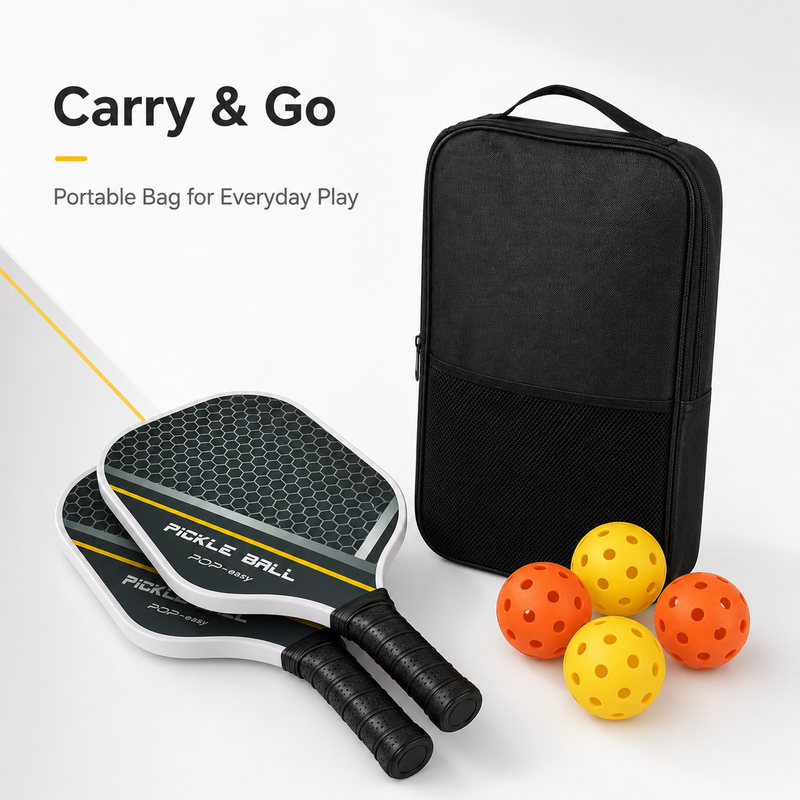
- Complementary pickleball balls and paddle accessories for complete product line sourcing
Request a paddle specification consultation — tell us your target market, price point, and performance priorities, and we will recommend the optimal core configuration.
Frequently Asked Questions
What is the best pickleball paddle core for beginners?
A 16mm PP honeycomb core (Gen 1 or Gen 2) offers the best balance of forgiveness, control, and affordability for beginners. The thicker core provides a larger sweet spot and softer feel, making it easier to learn proper technique. Fiberglass face sheets add a natural trampoline effect that helps generate power without perfect contact.
Why are thermoformed paddles more expensive than cold-pressed?
Thermoforming requires heated molds (150–200°C), higher press tonnage (50–100 tons vs 10–20 tons for cold press), pre-impregnated face materials (more expensive than dry fabric + adhesive film), and tighter process control. The per-unit manufacturing cost is approximately 30–50% higher, but the resulting paddle has better consistency, a larger sweet spot, and no edge guard failure point.
Does core thickness affect paddle weight?
Minimally. A 16mm PP honeycomb core weighs only about 0.3–0.5 oz more than a 13mm core of the same material. The bigger weight factors are face material (carbon fiber vs fiberglass) and edge treatment (edge guard vs wrapped). Most players cannot feel the weight difference between 13mm and 16mm cores.
What is the difference between Gen 2 and Gen 3 thermoformed paddles?
Gen 2 is a thermoformed unibody with honeycomb core throughout. Gen 3 adds a compressed foam perimeter ring around the honeycomb, which increases the sweet spot size, adds a trampoline effect for more power, and reduces vibration on off-center hits. Gen 3 paddles typically cost 15–25% more than equivalent Gen 2 paddles.
Can I mix core materials in a single paddle order?
Yes. Many OEM brands order multiple SKUs with different core configurations to cover different market segments. For example: a Gen 1 fiberglass/16mm paddle for recreational ($40–60 retail), a Gen 2 T700 carbon/16mm paddle for intermediate ($100–150 retail), and a Gen 3 T700 carbon/14mm paddle for advanced ($180–250 retail). We can produce all three under your brand with consistent quality.