Two Processes, Two Very Different Balls
Not all pickleball balls are created equal — and the manufacturing process is the single biggest factor determining quality, durability, and flight consistency. Today, virtually all pickleball balls are produced using one of two methods: rotational molding (also called rotomolding) or injection molding. Each process creates a fundamentally different product structure, and understanding the difference is essential for any OEM buyer evaluating suppliers.
The short version: rotational molding produces a seamless, one-piece ball with uniform wall thickness. Injection molding produces two hemispheres that are bonded together, creating a seam. That seam — however small — affects everything from flight stability to lifespan.
This guide walks through both processes step by step, compares the resulting product quality, and helps you decide which is right for your market positioning and price point.
Rotational Molding: The Seamless Advantage
Sourcing Outdoor Pickleball Balls?
Review our 40-hole ball model and send your quantity, color, packaging and destination requirements.
Process Overview
Rotational molding (rotomolding) creates a hollow, one-piece ball in a single molding cycle. Here is the step-by-step workflow:
- Material loading: Precisely measured PE or TPE powder (or liquid resin) is loaded into a hollow, ball-shaped mold cavity. The mold is typically aluminum or stainless steel, CNC-machined to the exact ball diameter with hole pins in place.
- Heating and rotation: The mold is placed in an oven (typically 250–350°C for PE) and rotated simultaneously on two perpendicular axes (biaxial rotation). The rotation speed is slow — typically 4–20 RPM — allowing the molten polymer to coat the entire interior surface of the mold evenly through centrifugal force and gravity.
- Cooling: The mold is moved to a cooling station (air or water spray) while continuing to rotate. Controlled cooling prevents warping and ensures uniform crystallization of the polymer.
- Demolding: The mold is opened and the finished ball is removed. The hole pins create the holes during molding, so no secondary drilling is needed.
- Finishing: Minor flash at the mold parting line is trimmed. The ball is inspected, weighed, and tested.
Key Quality Characteristics
- Seamless construction: The entire ball is one continuous piece of polymer. There is no bonded joint, no glued seam, no weak line. This is the single most important quality advantage.
- Uniform wall thickness: Biaxial rotation distributes material evenly across the entire sphere. Wall thickness variation is typically ±0.15 mm or better, compared to ±0.3–0.5 mm in injection-molded halves.
- Consistent roundness: Without a seam ridge, the ball is more perfectly spherical. This translates to more predictable, stable flight — especially important for outdoor play where wind amplifies any asymmetry.
- Superior durability: The absence of a bonded seam eliminates the primary failure mode of injection-molded balls. Rotomolded balls typically last 30–50% longer under identical playing conditions.
- Better hole integrity: Holes are formed during molding (not drilled after), so hole edges are smooth and integral to the ball structure. No micro-cracks around hole edges.
Production Considerations
- Cycle time: 15–25 minutes per cycle (heating + cooling), but multiple molds can run simultaneously on a multi-arm machine
- Mold cost: Higher initial mold investment ($3,000–$8,000 per mold set) due to precision CNC machining of the ball cavity and hole pins
- Material flexibility: Can process a wide range of PE, TPE, and specialty polymers in powder or liquid form
- Output rate: Modern multi-arm rotomolding machines produce 200–500 balls per hour per mold set
Injection Molding: The Cost-Effective Alternative
Process Overview
Injection molding produces pickleball balls in two halves (hemispheres) that are subsequently joined. The workflow:
- Injection: Molten polymer (PE, PP, or TPE) is injected under high pressure (500–2,000 bar) into a hemispherical mold cavity. The mold includes pins that form the holes in each half.
- Cooling and ejection: The half-ball cools in the mold (10–30 seconds), then is ejected. Cycle time is much faster than rotomolding.
- Trimming: Gate marks and flash are trimmed from each hemisphere.
- Bonding: The two hemispheres are joined using one of several methods:
- Solvent bonding: A chemical solvent softens the mating edges, which are pressed together and cured
- Thermal bonding: The edges are heated and pressed together (hot plate welding)
- Ultrasonic welding: High-frequency vibration creates friction heat at the joint line
- Adhesive bonding: Industrial adhesive is applied to the mating surfaces
- Finishing: The seam is sanded or polished to reduce the ridge. The ball is inspected and tested.
Key Quality Characteristics
- Seam presence: No matter how well finished, a bonded seam creates a slight ridge or density variation around the ball equator. This affects aerodynamic symmetry — the ball may wobble or curve slightly in flight, especially at higher speeds.
- Wall thickness variation: Injection molding naturally produces thinner walls at the poles (farthest from the gate) and thicker walls near the gate. This asymmetry affects bounce consistency.
- Seam durability: The bonded joint is the weakest point. Repeated impact causes the seam to crack, split, or delaminate — this is the #1 failure mode of injection-molded pickleball balls.
- Higher bounce: The harder materials typically used in injection molding (and the slightly different structural dynamics of a two-piece shell) can produce a livelier bounce. Some players prefer this for power play.
- Hole quality: Holes are molded into each half, but the holes near the seam line may be partially obstructed or deformed during the bonding process.
Production Considerations
- Cycle time: 15–40 seconds per half-ball — significantly faster than rotomolding
- Mold cost: Lower initial investment ($1,500–$4,000 per mold set)
- Output rate: High-volume injection machines produce 1,000–3,000 half-balls per hour
- Secondary operations: Bonding, seam finishing, and inspection add labor cost and time
Head-to-Head Comparison
| Factor | Rotational Molding | Injection Molding |
|---|---|---|
| Construction | One-piece, seamless | Two-piece, bonded seam |
| Wall thickness uniformity | Excellent (±0.15 mm) | Moderate (±0.3–0.5 mm) |
| Roundness / sphericity | Superior | Good (seam ridge affects) |
| Flight stability | Excellent — no seam wobble | Good — minor seam effect |
| Durability (relative) | 30–50% longer lifespan | Standard lifespan |
| Primary failure mode | Surface wear / compression fatigue | Seam cracking / splitting |
| Bounce consistency | Very consistent ball-to-ball | More variation between batches |
| Cycle time | 15–25 min per cycle | 15–40 sec per half |
| Mold cost | Higher ($3K–$8K) | Lower ($1.5K–$4K) |
| Unit cost (high volume) | Moderate | Lower (10–20% cheaper) |
| Material options | PE, TPE powders/liquids | PE, PP, TPE pellets |
| Best for | Tournament-grade, premium, outdoor | Budget, recreational, indoor |
How the Seam Affects Real-World Play
For OEM buyers evaluating whether the cost premium of rotomolded balls is justified, consider these real-world performance differences:
Flight Wobble
A bonded seam creates a slight mass asymmetry — the seam area is denser (overlapping material) or has a ridge that disrupts laminar airflow. At the speeds typical of competitive play (30–60 mph on drives), this causes a measurable wobble or "knuckleball" effect. In casual play, most players will not notice. In tournament play, it is a legitimate complaint.
Bounce Predictability
When a ball with a seam ridge contacts the court surface, the bounce angle can vary depending on whether the seam contacts the surface first. Over hundreds of bounces in a session, this creates inconsistent rally rhythm. Seamless rotomolded balls bounce identically regardless of orientation.
Lifespan Economics
If a rotomolded ball lasts 8 games and an injection-molded ball lasts 5 games, the per-game cost is actually lower for the rotomolded ball even at a 15–20% higher unit price. For clubs and facilities buying in bulk, total cost of ownership favors rotomolded construction.
Quality Control: What to Inspect by Process Type
For Rotomolded Balls
- Check for uniform wall thickness (ultrasonic thickness gauge on sample balls)
- Verify no voids or air bubbles in the wall cross-section (cut-open sample inspection)
- Confirm hole edges are smooth with no internal flash
- Measure sphericity at 3 axes — variance should be ≤ 0.5 mm
- Bounce consistency: test 10 balls from the same batch, variance should be ≤ 1 inch
For Injection-Molded Balls
- Seam integrity is critical: Perform a pull-apart test on 3 sample balls — the seam should withstand ≥ 15 N of force
- Check seam ridge height — should be ≤ 0.3 mm above the ball surface
- Inspect holes near the seam for obstruction or deformation
- Verify both hemispheres have matching wall thickness at the equator
- Spin test: roll the ball on a flat surface and observe for wobble indicating mass asymmetry
Choosing the Right Process for Your Market
| Market Segment | Recommended Process | Rationale |
|---|---|---|
| Tournament / sanctioned play | Rotational molding | Flight consistency and durability meet competitive standards |
| Premium retail brand | Rotational molding | Seamless quality justifies premium pricing, fewer returns |
| Club / facility bulk supply | Rotational molding | Lower total cost of ownership despite higher unit price |
| Budget / recreational | Injection molding | Lower unit cost, acceptable quality for casual play |
| Promotional / event giveaway | Injection molding | Cost-effective for single-use or short-lifespan applications |
| Indoor-only facility | Either (injection OK) | Less abrasive environment reduces seam wear concern |
Sourcing from Global Carbon Sports
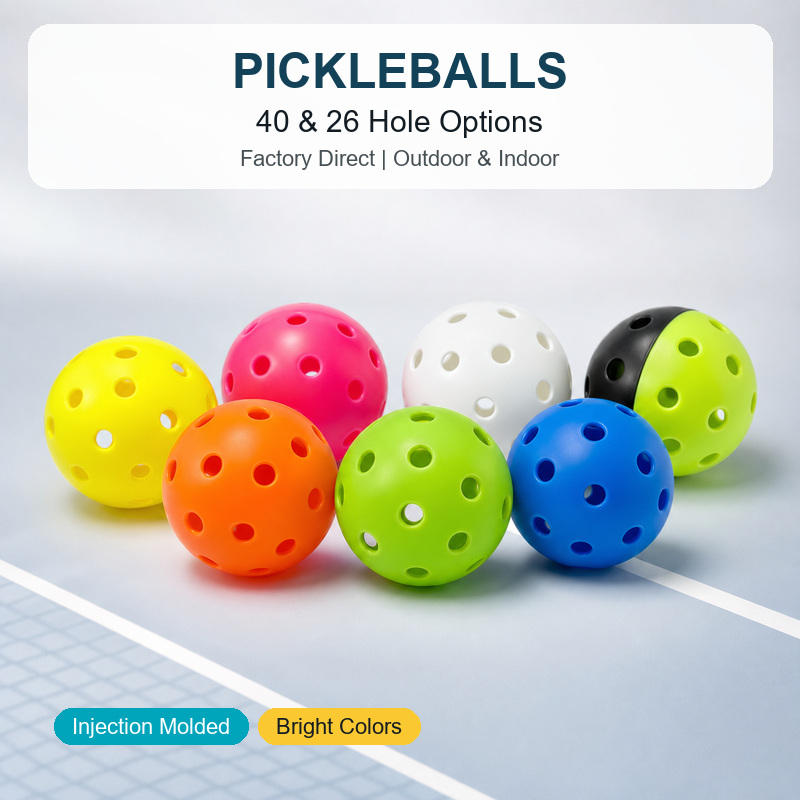
Global Carbon Sports manufactures pickleball balls using rotational molding as our standard process for all OEM orders. Our outdoor 40-hole pickleball balls feature:
- Seamless one-piece construction for superior flight stability
- UV-stabilized PE/TPE blend for extended outdoor lifespan
- USA Pickleball specification compliance (diameter, weight, bounce, hardness)
- Custom Pantone color matching and logo printing
- Batch consistency testing with documented QC reports
We also offer a complete pickleball paddle line for brands seeking a single-source supplier for balls and paddles.
Contact us for manufacturing specifications and pricing — tell us your target market, quantity, and quality requirements.
Frequently Asked Questions
Why do some pickleball balls split along the seam?
Injection-molded balls are made from two hemispheres bonded together. Repeated impact stress concentrates at the bonded joint, eventually causing the seam to crack or delaminate. This is the most common failure mode for injection-molded balls and does not occur with seamless rotomolded construction.
Is rotational molding more expensive than injection molding?
Per unit, rotomolded balls cost approximately 10–20% more due to longer cycle times and higher mold costs. However, the 30–50% longer lifespan means the per-game cost is often lower. For bulk buyers, total cost of ownership typically favors rotomolded balls.
Can you tell the difference by looking at the ball?
Yes. A rotomolded ball has no visible seam line — the surface is completely uniform. An injection-molded ball has a visible (and sometimes palpable) seam line around its equator where the two halves were joined. The seam may appear as a slight ridge, a color variation line, or a polished strip.
Which process produces a more consistent bounce?
Rotational molding produces more consistent bounce because the uniform wall thickness means the ball deforms identically regardless of impact orientation. Injection-molded balls can have slight bounce variation depending on whether the seam contacts the surface.
What is the typical lead time for a custom rotomolded pickleball ball order?
For a new custom mold (new hole pattern or diameter), allow 25–35 days including mold fabrication. For repeat orders using existing molds, production lead time is 15–20 days depending on quantity. Pre-production samples are available within 7–10 days.