Weight Is the Most Overlooked Spec in Pickleball Paddle Design
When OEM buyers evaluate pickleball paddle samples, they typically focus on face material, core type, and surface texture. But the single specification that most directly affects how a paddle feels in a player's hand is its weight and balance. A paddle with the perfect face material and core construction will still fail in the market if the weight is wrong for the target player.
Weight affects everything: swing speed, power generation, control precision, reaction time at the net, and player fatigue over a multi-hour session. For OEM brands, getting the weight specification right is as important as choosing the right carbon fiber grade — and far more nuanced than most buyers realize.
This guide covers the complete science of pickleball paddle weight and balance, from the physics of swing weight to practical OEM specification recommendations for every market segment.
Pickleball Paddle Weight Categories
هل تبحث عن مصنع OEM لمضارب البيكلبول؟
تصفح خطوط مضارب البيكلبول من ألياف الكربون والألياف الزجاجية، أو اطلب عرض أسعار مخصص.
Pickleball paddles in 2026 typically range from 7.3 to 8.5 ounces (207–241 grams). The market has settled into three broad categories:
| Category | Weight Range | Typical Use | Player Profile |
|---|---|---|---|
| Lightweight | 7.3–7.8 oz (207–221 g) | Quick hands, dinking, net play | Advanced/competitive, doubles specialists, players with arm issues |
| Midweight | 7.8–8.2 oz (221–232 g) | All-around play | Intermediate to advanced, most popular category |
| Heavyweight | 8.2–8.5+ oz (232–241+ g) | Power, baseline drives | Power players, singles players, former tennis players |
Market reality: Midweight paddles (7.8–8.2 oz) account for approximately 60–65% of the US market. Lightweight paddles are the fastest-growing segment (driven by the competitive doubles trend), while heavyweight paddles serve a smaller but loyal niche.
How Weight Affects Performance
Power
Heavier paddles generate more power through simple physics: momentum = mass × velocity. A heavier paddle carries more momentum at the same swing speed, transferring more energy to the ball on impact. However, a heavier paddle is also harder to swing fast — so the relationship is not linear.
Practical effect: An 8.4 oz paddle hit at 30 mph generates approximately 8% more ball speed than a 7.5 oz paddle hit at the same speed. But most players swing a lighter paddle 5–10% faster, which can offset the mass advantage.
Control and Touch
Lighter paddles offer superior control for several reasons:
- Faster reaction time: Less mass means less inertia to overcome when adjusting paddle angle at the net
- Better feel: Lighter paddles transmit more vibration feedback to the hand, giving players better "touch" on soft shots
- Reduced overshoot: Less momentum means the paddle is easier to stop, preventing dinks from sailing long
Maneuverability and Reaction Time
At the net (the "kitchen line"), reaction volleys happen in 200–400 milliseconds. A lighter paddle can be repositioned 15–20% faster than a heavy paddle in this timeframe. This is why competitive doubles players overwhelmingly prefer lightweight paddles.
Player Fatigue
A typical pickleball session lasts 2–4 hours with hundreds of swings per hour. The cumulative effect of paddle weight on arm, shoulder, and wrist fatigue is significant:
- A 7.5 oz paddle over 3 hours: approximately 12,000–15,000 total swings, cumulative load ~5,600–7,000 lb
- An 8.4 oz paddle over 3 hours: same swing count, cumulative load ~6,300–7,900 lb
- The 12–15% difference in cumulative load translates to noticeably less fatigue with the lighter paddle
This is particularly important for the 50+ demographic that represents the largest pickleball player segment in the US.
Balance Point: The Hidden Variable
Two paddles can weigh exactly the same but feel completely different based on their balance point. The balance point is the location along the paddle's length where it balances perfectly on a fulcrum.
| Balance Type | Balance Point | Feel | Best For |
|---|---|---|---|
| Head-Heavy | Closer to paddle face (>50% from handle) | More powerful, "plow-through" feel | Baseline power, drives, serves |
| Even Balance | Center of paddle (~50%) | Neutral, versatile | All-around play, most popular |
| Handle-Heavy (Head-Light) | Closer to handle (<50% from handle) | More maneuverable, quick hands | Net play, dinking, fast volleys |
Key insight: A head-heavy 7.8 oz paddle can feel more powerful than an even-balanced 8.2 oz paddle, because the mass is concentrated where it matters most — at the hitting surface. Conversely, a handle-heavy 8.2 oz paddle can feel as quick as a 7.5 oz even-balanced paddle.
Swing Weight vs Static Weight
Static weight (what you see on the spec sheet) tells only part of the story. Swing weight measures how heavy the paddle feels during an actual swing, and it depends on both mass and mass distribution:
- Swing weight = mass × (distance from pivot point)²
- A paddle with mass concentrated at the head has a higher swing weight than one with the same mass concentrated at the handle
- Swing weight is measured in kg·cm² and typically ranges from 100–140 for pickleball paddles
OEM implication: When specifying paddle weight, also specify the target balance point. A 7.8 oz paddle with a 240 mm balance point (from handle end) will play very differently from a 7.8 oz paddle with a 220 mm balance point.
What Determines Paddle Weight?
The total weight of a pickleball paddle is the sum of its components:
| Component | Weight Contribution | Variables |
|---|---|---|
| Face material (2 layers) | 30–80 g | Carbon fiber (30–50 g) vs fiberglass (50–80 g) |
| Core | 80–130 g | PP honeycomb thickness (13mm–20mm), density |
| Edge guard | 10–20 g | Material (plastic vs carbon), coverage |
| Grip + handle | 25–40 g | Grip material, cushion thickness, handle length |
| Adhesive + resin | 10–20 g | Bonding method, resin content |
| Graphics / finish | 2–5 g | Paint, decals, clear coat |
| Total | 157–295 g (5.5–10.4 oz) | Practical range: 207–241 g (7.3–8.5 oz) |
As covered in our core technology guide, the core is the single largest weight contributor. A 16mm PP honeycomb core weighs approximately 100–110 g, while a 13mm core weighs 80–90 g and a 20mm core weighs 120–130 g.
Weight Control in OEM Manufacturing
Consistent weight is one of the most challenging quality control targets in pickleball paddle manufacturing. Here is how weight variation occurs and how to control it:
Sources of Weight Variation
- Core density variation: PP honeycomb from different batches can vary ±5% in density. This is the largest source of weight variation.
- Resin content: In wet layup processes, the amount of resin applied to the face fabric varies by operator. ±10% resin variation = ±3–5 g weight variation.
- Face fabric weight: Carbon fiber prepreg has a specified areal weight (e.g., 200 g/m²), but actual weight can vary ±3%.
- Trimming: How much excess material is trimmed from the edges affects final weight by 2–5 g.
- Grip installation: Grip wrap tension and overlap affect weight by 1–3 g.
OEM Weight Tolerance Recommendations
| Quality Tier | Weight Tolerance | Inspection Method |
|---|---|---|
| Premium (tournament grade) | ±2 g per unit, ±3 g per batch | 100% individual weighing + batch statistical analysis |
| Standard (retail grade) | ±3 g per unit, ±5 g per batch | 100% individual weighing |
| Economy (promotional grade) | ±5 g per unit | Sample weighing (10% of batch) |
Weight Specifications by Market Segment
| Market Segment | Target Weight | Target Balance | Why |
|---|---|---|---|
| Professional / Tournament | 7.5–7.9 oz | Even to slightly head-light | Maximum maneuverability for competitive doubles |
| Advanced / Competitive | 7.8–8.1 oz | Even balance | Balanced power and control |
| Intermediate | 7.9–8.3 oz | Even balance | Forgiving weight, versatile play |
| Recreational | 7.8–8.2 oz | Even to slightly head-heavy | Easy to generate power without fast swings |
| Senior / 50+ | 7.3–7.8 oz | Head-light | Minimum fatigue, easy maneuverability |
| Power / Singles | 8.2–8.5 oz | Head-heavy | Maximum drive power from baseline |
| Youth / Junior | 6.8–7.5 oz | Head-light | Light enough for smaller arms |
| Promotional | 7.8–8.2 oz | Even | Universal appeal, safe default |
Weight and Face Material Interaction
The choice of face material (covered in our carbon fiber vs fiberglass guide) directly impacts the weight budget available for other components:
- Carbon fiber face (30–50 g): Saves 20–30 g vs fiberglass. This weight savings can be redistributed to the core (thicker = more power) or kept as overall lighter weight.
- Fiberglass face (50–80 g): Heavier face limits core thickness options if targeting a lightweight paddle. A fiberglass paddle targeting 7.5 oz total must use a thinner (13mm) core.
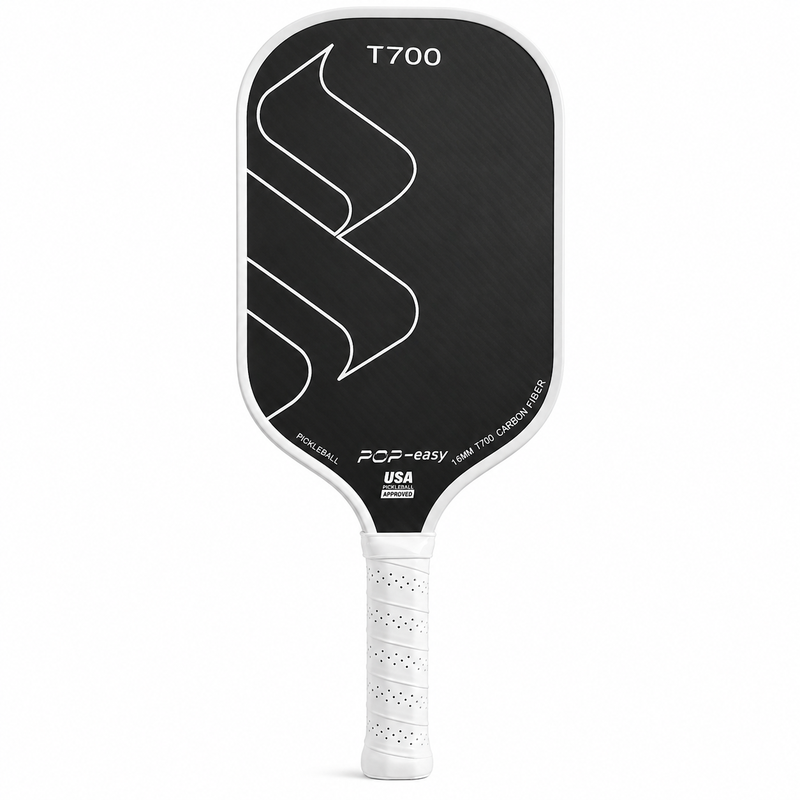
Example: A T700 carbon fiber paddle with 16mm core: face 40 g + core 105 g + edge 15 g + grip 30 g + adhesive 15 g = 205 g (7.2 oz). Add 5 g for graphics = 210 g (7.4 oz) — right in the lightweight sweet spot.
Testing and Quality Assurance
For OEM orders, we recommend the following weight-related QC protocol:
- Pre-production samples: 3–5 samples weighed to verify target weight ± tolerance
- Balance point measurement: Measure balance point from handle end using a balance beam. Target ±5 mm tolerance.
- Swing weight testing: For premium lines, use a swing weight machine (e.g., Babolat RDC) to verify swing weight consistency
- Production batch sampling: Weigh every paddle (100% inspection for premium/standard; 10% for economy)
- Statistical process control: Track weight distribution across batches. Flag any batch where standard deviation exceeds 2 g.
Sourcing from Global Carbon Sports
Global Carbon Sports offers precise weight control across all paddle lines from our Guangzhou facility:
- Premium T700 Carbon Fiber Paddles — Available in 7.4–8.0 oz with custom balance point specification
- Wholesale T700 Carbon Fiber Paddles — Standard 7.8–8.2 oz, even balance
- Fiberglass Paddles — 7.8–8.3 oz, customizable weight and balance
- Complementary pickleball balls and paddle accessories
Need help dialing in the perfect weight spec for your market? Request a weight specification consultation — tell us your target player, play style, and price point.
Frequently Asked Questions
What is the most popular pickleball paddle weight?
The most popular weight range is 7.8–8.2 oz (midweight), accounting for approximately 60–65% of the US market. This range offers the best balance of power, control, and maneuverability for the widest range of players. For OEM brands unsure of their target weight, 8.0 oz with even balance is the safest default.
Does a heavier paddle always generate more power?
Not necessarily. While a heavier paddle carries more momentum at the same swing speed, most players swing a lighter paddle faster. The net effect depends on the individual player. For players with fast, full swings (tennis background), a heavier paddle adds power. For players with compact, quick swings (pickleball-native), a lighter paddle often generates equal or more power through higher swing speed.
How much does paddle weight tolerance matter for retail sales?
For premium and competitive paddles, weight consistency is critical. Serious players weigh paddles before purchase and will return products that do not match the stated spec. We recommend ±2 g tolerance for premium lines and ±3 g for standard retail. Promotional paddles can accept ±5 g tolerance.
Can I customize the balance point of an OEM paddle?
Yes. Balance point is controlled by the distribution of mass within the paddle — primarily the core shape, edge guard weight, and handle construction. We can adjust the balance point by ±15 mm from the default even balance. Specify your target balance point (measured from handle end in mm) in your RFQ.
What weight paddle is best for senior players?
For players aged 50+, we recommend 7.3–7.8 oz with a head-light balance. This minimizes arm and shoulder fatigue during multi-hour sessions while maintaining quick reaction at the net. Carbon fiber faces are ideal because they save 20–30 g vs fiberglass, allowing a thicker (more forgiving) core within the same total weight.