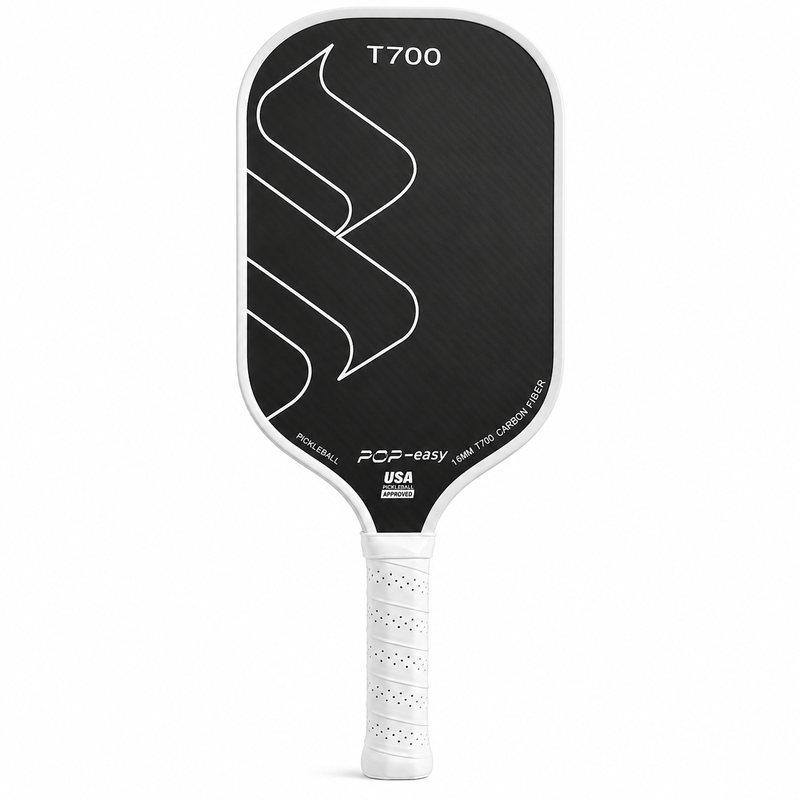
Direct Answer for B2B Buyers: For 80% of performance and club pickleball brands, peel-ply unidirectional (UD) Toray T700 raw carbon fiber is the benchmark face sheet because its 230 GPa tensile modulus balances ball dwell time (pocketing), durable topspin friction, and impact toughness. T800 carbon fiber (294 GPa modulus) creates a stiffer, higher-pop face for power-oriented pro models (quoted by RFQ), 3K / 18K woven carbon delivers signature twill aesthetics, and 13 mm cold-pressed fiberglass provides the best full-color UV graphic fidelity for schools, clubs, hotels, and starter sets. Both cold-pressed fiberglass and cold-pressed 16 mm T700 paddles start from 30 paddles with your custom logo and face artwork.
- Best All-Around Pro & Club Face: Peel-ply raw Toray T700 (16 mm standard or 16.5 in elongated, custom logo from 30 paddles in cold-pressed construction).
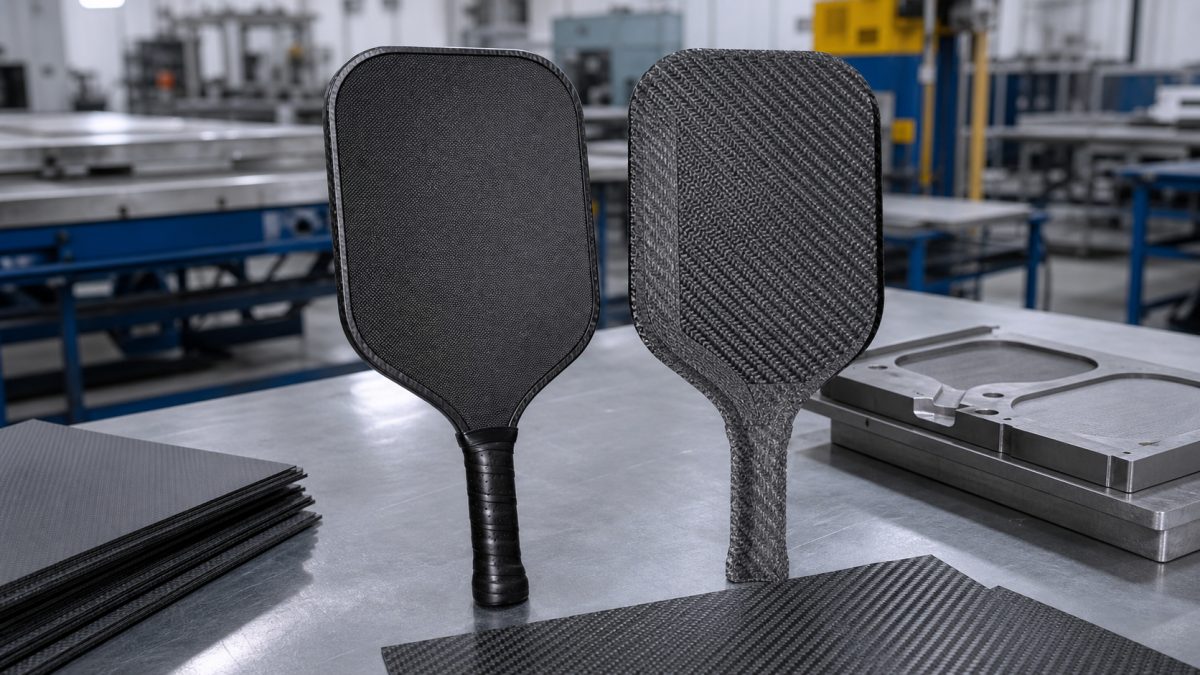
- Best for Stiff Power & Fast Drive Speed: High-modulus T800 or thermoformed unibody T700 with perimeter foam injection (quoted by project RFQ).
- Best for Visible Carbon Weave Aesthetics: 3K (2×2 twill) or 18K triaxial woven carbon fiber sheets.
- Best for Full-Color Graphics & Institutional Budgets: 13 mm cold-pressed fiberglass (custom face artwork and logo from 30 paddles).
1. What Is the Difference Between T700 and T800 Carbon Fiber in Pickleball Paddles?
Many buyers who know T700 and T800 from badminton rackets assume T800 is automatically superior for every pickleball paddle. In pickleball paddle engineering, the mechanics work differently because a paddle face impacts a rigid perforated polymer ball across a flat honeycomb core rather than deflecting a stringed frame:
- Toray T700 Raw Carbon ( ~4,900 MPa tensile strength / ~230 GPa tensile modulus ): Offers slightly higher elongation at break (~2.1%), allowing the face laminate to flex microscopically over a 16 mm polypropylene honeycomb core. That micro-deflection increases ball dwell time on the face, helping players control third-shot drops, kitchen dinks, and heavy topspin drives.
- T800 Intermediate-Modulus Carbon ( ~5,490 MPa tensile strength / ~294 GPa tensile modulus ): Approximately 25–28% stiffer in tensile modulus than T700. On a pickleball paddle, T800 rebounds faster with less pocketing—producing a crisp, explosive pop favored by aggressive baseline drivers, but requiring tighter player technique on soft resets.
2. B2B OEM Face Material Comparison Table: T700 vs T800 vs 3K/18K vs Fiberglass
Looking for a Pickleball Paddle OEM Factory?
Browse our carbon fiber and fiberglass pickleball paddle lines, or request a custom quote.
| Parameter | Raw Toray T700 (UD) | T800 Carbon (UD) | 3K / 18K Woven Carbon | High-Tensile Fiberglass |
|---|---|---|---|---|
| Tensile Modulus | ~230 GPa (Balanced flex) | ~294 GPa (High stiffness) | ~230–240 GPa (Woven grid) | ~70–85 GPa (High deflection pop) |
| Surface Texture | Peel-ply micro-frosted raw carbon | Peel-ply raw unidirectional | Twill / checkerboard weave | Smooth UV full-color printed face |
| Ball Feel & Spin | High dwell time + sustained spin | Crisp, firm pop + fast rebound | Balanced feel + visual carbon grid | Lively rebound + easy power |
| Recommended Core | 16 mm control (Standard or 16.5 in) | 14 mm power or 16 mm hybrid | 14 mm or 16 mm PP honeycomb | 13 mm PP honeycomb power core |
| Factory MOQ Route | From 30 paddles (Cold-pressed) / RFQ (Thermoformed) | Custom layup by project RFQ | Custom layup by project RFQ | From 30 paddles (Cold-pressed) |
3. Unidirectional (UD) Raw T700 vs 3K, 12K, and 18K Woven Carbon
The numbers 3K, 12K, and 18K do not measure carbon hardness—they count how many carbon filaments (3,000, 12,000, or 18,000) are bundled into each woven tow:
- Unidirectional (UD) Raw T700: Fibers lie flat and parallel in alternating 0°/90° plies without crimp crossovers. When cured with sacrificial peel-ply fabric, the entire hitting zone has uniform micro-roughness in every direction.
- 3K & 18K Woven Carbon: Interlaced carbon tows create a visible small-grid (3K) or wide-ribbon checkerboard (18K) appearance. Because weave intersections create slight resin valleys, woven faces are often chosen by brands that want an unmistakable carbon visual identity alongside durable stiffness.
4. How to Pair Face Materials With Shapes and Core Thickness (13 mm vs 16 mm)
Instead of launching overlapping SKUs, successful B2B buyers structure their line around distinct player roles:
- SKU Path A — All-Court Control & Spin (Standard 16 mm T700 Raw Carbon Paddle): 15.7 × 7.9 in wide face + 16 mm PP honeycomb core (~220–230 g). Custom logo from 30 paddles.
- SKU Path B — Singles Reach & Two-Handed Backhand (Elongated 16.5 × 7.5 in T700 Raw Carbon Paddle): 16 mm core + 5.3 in long handle (~230 g). Custom logo from 30 paddles.
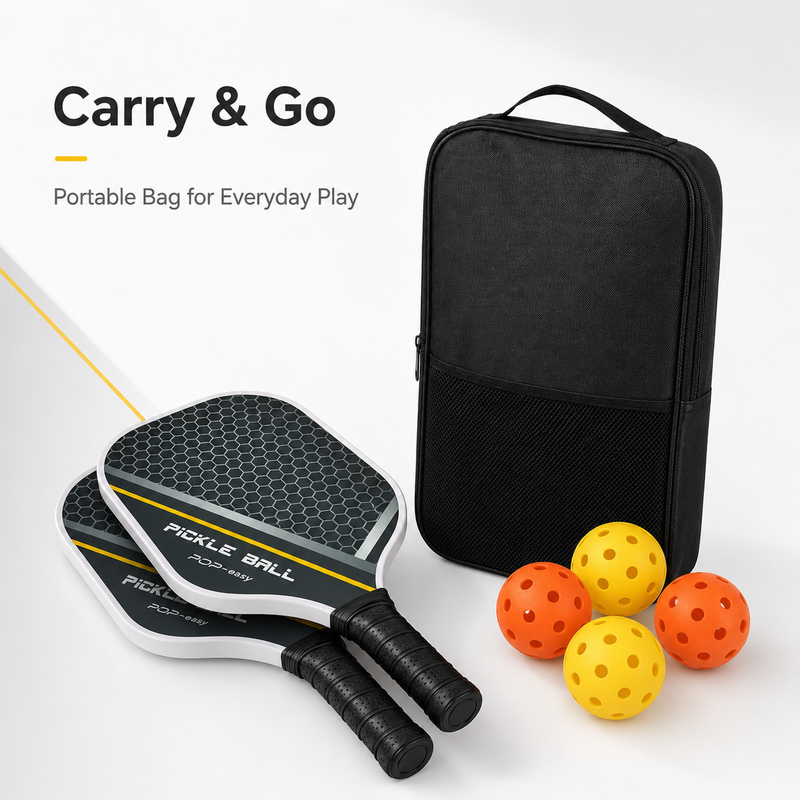
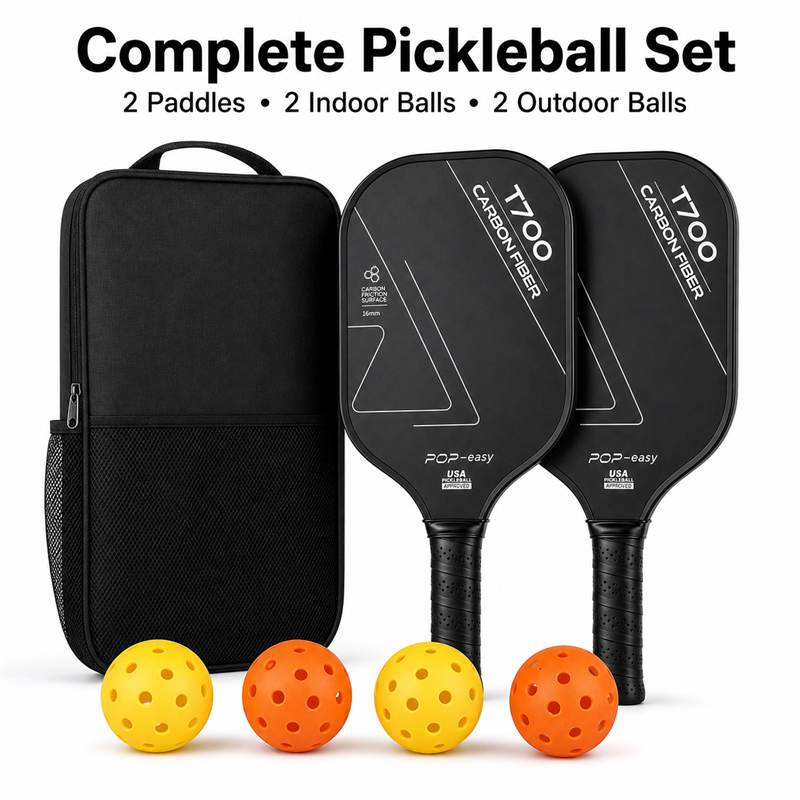
- SKU Path C — Schools, Clubs, Hotels & Retail Sets (13 mm Cold-Pressed Fiberglass Paddle & 2-Paddle Set): Full-face UV artwork from 30 paddles, available as single paddles or 2-paddle sets with 4 outdoor balls and a carry bag.
5. Frequently Asked Questions (B2B Buyer FAQ)
Can we mix fiberglass and T700 raw carbon paddles to test our market?
Yes. Each model starts at 30 paddles with your custom logo and face artwork, allowing a brand or club to order 30 fiberglass paddles and 30 T700 raw carbon paddles (or 15 two-paddle sets of each) in one combined shipment.
Should we choose cold-pressed or thermoformed unibody for a first T700 launch?
If you want to validate designs, price points, or club demand with 30–100 paddles and zero mold cost, start with our cold-pressed 16 mm T700 route. When scaling a signature tournament model with edge-foam injection and carbon-sealed rails, request a thermoformed unibody quote via our T700 Raw Carbon OEM Factory page.
How do we request a sample and bulk quote?
Submit your target face material, shape (standard or 16.5 in elongated), quantity per design, and packaging format (single paddle vs 2-paddle set) on our OEM RFQ page.