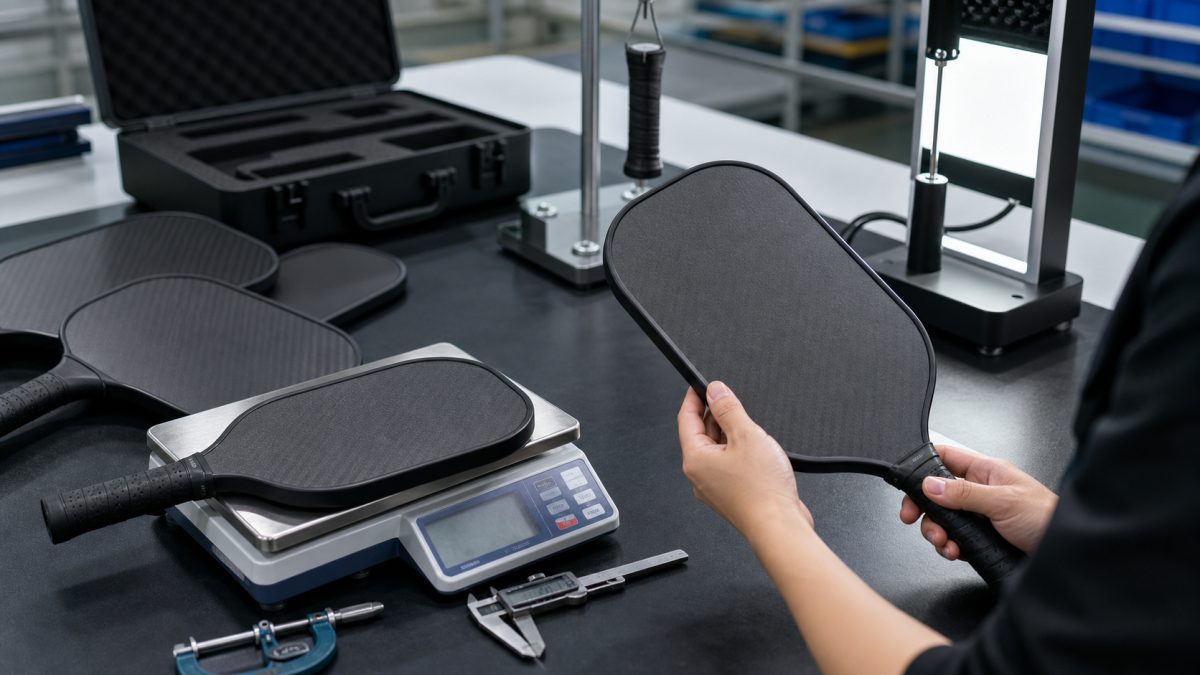
Why Quality Control Matters in Badminton Racket OEM Manufacturing
For distributors, brand owners and sports retailers sourcing badminton rackets from China, quality control is the single most decisive factor between profit and costly returns. According to the Badminton World Federation, the global badminton racket market exceeded $1.2 billion in 2025 (Grand View Research), and the stakes rise with every shipment. A batch of defective frames or incorrect balance points can wipe out a season's margin.
This guide explains the AQL (Acceptable Quality Level) standards used in racket manufacturing, provides a step-by-step inspection checklist, and shows OEM buyers how to set up a QC protocol that protects both brand reputation and buyer relationships.
Understanding AQL Standards for Carbon Fiber Rackets
Need a Carbon Fiber Badminton Racket Manufacturer?
Explore our T700/T800 and 40T high modulus racket series, or send your OEM specifications.
AQL is the internationally recognized sampling method defined by ISO 2859-1. It determines how many units to inspect in a batch and how many defects are acceptable before rejecting the entire lot. Most professional racket factories use three AQL tiers:
| Defect Category | AQL Level | Examples |
|---|---|---|
| Critical | 0 | Structural cracks, delamination, sharp edges that cause injury |
| Major | 2.5 | Weight deviation ±3 g from spec, balance point off by ±3 mm, paint peeling |
| Minor | 4.0 | Cosmetic color mismatch (<10% surface), minor logo misalignment |
For a typical OEM order of 500 rackets, the General Inspection Level II sampling plan requires inspecting 80 units. Under AQL 2.5 for major defects, the batch is accepted if no more than 5 units show major defects; 6 or more trigger full sorting or rejection.
Sampling Plan Example
- Order quantity: 500 rackets
- Sample size (GIL-II): 80 rackets
- Accept/Reject (Major, AQL 2.5): 5 / 6
- Accept/Reject (Minor, AQL 4.0): 7 / 8
- Critical: Zero tolerance — any single critical defect fails the batch
Pre-Production QC: Setting the Foundation
Quality issues are cheapest to prevent before production begins. Smart buyers establish three documents before the first racket leaves the mold:
1. Approved Golden Sample
A signed-off physical sample that defines the target for weight, balance, flex, paint finish and packaging. Both buyer and factory retain one copy. This becomes the reference for all inspections and dispute resolution.
2. Technical Specification Sheet
A detailed document covering:
- Frame material grade (e.g., T700/T800/40T high modulus carbon fiber)
- Weight tolerance (±2 g is industry standard for premium rackets)
- Balance point range (head-heavy: 295-305 mm; even: 285-295 mm; head-light: ≤285 mm)
- String tension rating (e.g., 24-30 lbs for competition-grade frames)
- Shaft flex rating (S/M/F/EF — stiff to extra-flexible)
- Grip size and material (G4/G5 standard; PU vs towel grip)
3. Packaging Specification
Specifies racket sleeve type, individual box dimensions, outer carton strength (minimum B/C flute corrugated, 7-ply for international shipping), and carton drop-test requirements (ISTA 2A standard).
In-Process and Pre-Shipment Inspection Checklist
The following checklist covers the critical inspection points at factory gate. Distributors can either assign a third-party inspector (SGS, BV, QIMA) or verify upon receipt.
Visual and Dimensional Checks
- Frame integrity: Inspect each sampled racket under bright light for cracks, voids, or delamination at the T-joint, throat and frame apex. Tap lightly with a metal object — a clear ring indicates good bonding; a dull thud suggests internal delamination.
- Weight measurement: Use a calibrated digital scale (0.1 g resolution). Flag any unit deviating more than ±2 g from spec.
- Balance point: Measure from the bottom of the handle using a balance point gauge. Tolerance: ±3 mm.
- Shaft straightness: Roll the shaft on a flat surface. Any visible wobble exceeding 1 mm is a major defect.
- Grommet alignment: All 22-24 string holes should pass freely through the grommet strip. Misaligned grommets cause premature string breakage.
- Paint and decals: Under D65 standard lighting, check for color consistency across the batch using a Pantone swatch. Minor variations within ΔE < 2.0 are acceptable; ΔE 2.0-4.0 is a minor defect; ΔE > 4.0 is major.
Performance Testing
- String tension test: String 3 sample rackets to the rated maximum tension (e.g., 30 lbs). Hold for 24 hours, then inspect for frame distortion or grommet pull-through.
- Drop test: Wrap 3 rackets in standard packaging and drop from 76 cm onto a concrete surface (ISTA 2A). No structural damage or cosmetic damage beyond minor scuffing is acceptable.
- Sweat resistance: Wipe the grip and painted frame with a cloth soaked in artificial sweat solution (ISO 105-E04) for 4 hours. No paint discoloration or grip degradation should occur.
Common Defects and Their Root Causes
Understanding why defects occur helps buyers negotiate better terms and work proactively with their factory. Here are the top five issues found in carbon-fiber badminton rackets:
| Defect | Root Cause | Prevention |
|---|---|---|
| T-joint cracking | Insufficient resin content at the joint; uneven layup | Request joint cross-section photos during prototyping |
| Uneven paint finish | Poor masking during spray painting; dust contamination | Specify clean-room painting (Class 10,000 or better) |
| Weight inconsistency | Variable carbon fiber areal weight; inconsistent resin ratio | Request pre-preg material certificates from the factory's supplier |
| Grommet脱落 | Wrong grommet material (low-temp vs high-temp nylon) | Specify high-temp PA66 grommets rated to 260℃ |
| Shaft flex variance | Inconsistent carbon fiber orientation in the layup schedule | Implement a layup checklist with visual markers per layer |
Third-Party Inspection vs In-House QC
Distributors have two main options for verifying quality before shipment:
| Factor | Third-Party (SGS/BV/QIMA) | In-House Factory QC |
|---|---|---|
| Cost | $200-$400 per inspection day | Included in unit price |
| Independence | Unbiased, internationally recognized reports | Potential conflict of interest |
| Lead time | Requires 3-5 business days to book | Immediate |
| Best for | New factories, first orders, compliance requirements | Established partnerships, repeat orders |
Recommendation: Use third-party inspection for the first 2-3 orders with any new factory. Once trust is established, transition to in-house QC with periodic third-party audits (quarterly or bi-annual).
Building a QC Clause into Your OEM Contract
A well-drafted quality clause protects the buyer without creating adversarial relations. Key elements include:
- Inspection right: Buyer or designated third party may inspect at the factory before shipment
- Defect resolution: Factory replaces defective units within 15 business days at their cost (materials + shipping)
- Warranty period: Minimum 6 months from shipment date for structural defects; 3 months for cosmetic issues
- Batch traceability: Each carton labeled with production date, batch number and inspector ID
- Penalty for critical defects: Full batch rejection with factory covering return freight and re-production costs
Internal Links: Related Reading
If you're evaluating OEM partners, our Complete Guide to Carbon Fiber Badminton Racket Manufacturing covers the full production process. For pricing benchmarks, see our Badminton Racket Pricing Strategy Guide 2026. And for import compliance, check our Import Regulations by Country guide.
Frequently Asked Questions
What is a standard AQL for badminton racket inspection?
The industry standard is AQL 0 for critical defects, AQL 2.5 for major defects, and AQL 4.0 for minor defects, applied at General Inspection Level II of ISO 2859-1. For a 500-unit order, this means inspecting 80 random samples with acceptance thresholds of 0/5/7 respectively.
How much does a third-party racket inspection cost?
Companies like SGS, Bureau Veritas and QIMA charge approximately $200-$400 per inspector-day, typically covering 80-120 units inspected. For a $15,000 order, this represents only 1-3% of order value — a small investment compared to the cost of a rejected retail batch.
What weight tolerance is acceptable for OEM rackets?
Premium-grade rackets should maintain a weight tolerance of ±2 grams from the specified weight (e.g., 85g ± 2g). Mid-range rackets typically use ±3 grams. Any deviation beyond these ranges affects player feel and balance, and should be flagged as a major defect.
How do I check for T-joint integrity without destructive testing?
The tap test is the most common non-destructive method. Strike the T-joint lightly with a small metal rod or coin. A clear, ringing sound indicates good resin bonding and structural integrity. A dull or hollow sound suggests delamination or insufficient resin at the joint — this is a critical defect.
What should a badminton racket warranty cover?
A comprehensive OEM warranty covers structural defects (frame cracking, T-joint failure, shaft deformation) for at least 6 months from the shipment date. Cosmetic issues should carry a minimum 3-month warranty. The warranty should include free replacement of defective units with the factory absorbing return freight costs.
What is the typical MOQ for a custom-branded badminton racket line?
Most Chinese carbon fiber racket factories offer OEM with an MOQ of 200-300 units per model for an existing mold, and 500-1,000 units for fully custom designs requiring new molds. Full custom paint and packaging typically add 2-3 weeks to the production timeline.