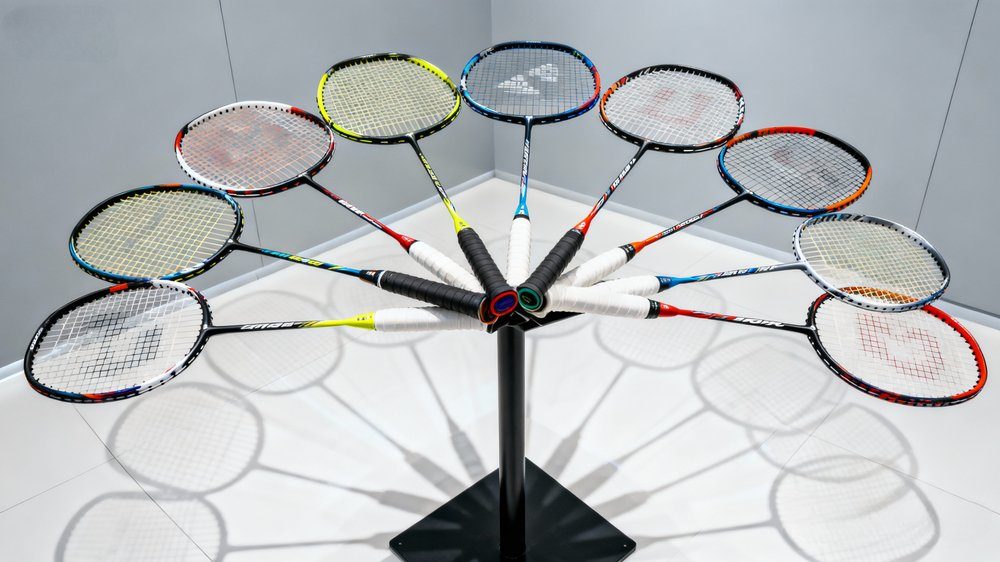
Understanding Carbon Fiber Materials
Carbon fiber has revolutionized the badminton industry, offering unprecedented strength-to-weight ratios that allow for faster, more powerful rackets. In this comprehensive guide, we explore the manufacturing process from raw materials to finished products.
Types of Carbon Fiber
The most commonly used carbon fibers in badminton racket manufacturing include:
- T700 - Standard high-performance carbon fiber with excellent balance of strength and cost
- T800 - Premium grade offering higher modulus and tensile strength
- 40T/46T High Modulus - Ultra-high performance materials for professional rackets
Manufacturing Process
Our state-of-the-art facility employs a multi-stage process to ensure consistent quality across all products.
From Racket Specification to Finished Product
Need a Carbon Fiber Badminton Racket Manufacturer?
Explore our T700/T800 and 40T high modulus racket series, or send your OEM specifications.
A carbon fiber badminton racket should begin with a buyer-approved specification, not only a target weight or a material name. The specification should define the intended player profile, weight class, balance range, shaft feel, maximum stringing requirement, grip size, finish, logo placement, packaging and inspection method. These choices affect the frame layup, shaft construction and production controls.
1. Engineering and Layup Planning
The supplier converts the product target into frame and shaft layup instructions. Carbon prepreg orientation, reinforcement zones and resin control influence stiffness, impact behavior and consistency. High-modulus material can be used selectively where stiffness or weight reduction is required; using the highest grade everywhere is not automatically the best design.
2. Prepreg Cutting and Wrapping
Prepreg pieces are cut to controlled shapes and wrapped around a mandrel or bladder according to the layup schedule. Fiber direction, overlap position and material handling must remain consistent. Poor alignment or contamination at this stage can create weak areas that may only become visible during stringing or use.
3. Molding and Curing
The wrapped structure is placed in a mold and cured under controlled heat and pressure. The process consolidates the laminate and forms the racket geometry. Buyers should ask how curing parameters are recorded and how the factory separates approved settings for different models.
4. Finishing, Drilling and Assembly
After demolding, the frame is trimmed, sanded, drilled and prepared for paint and decals. Grommet holes, joint areas, surface finish and final geometry require inspection. The shaft, cone, handle and grip are assembled according to the approved balance and weight target.
5. Final Quality Control
Final inspection should measure the agreed weight and balance range, shaft and frame alignment, handle and cone assembly, paint and decal quality, grommet condition and packaging. Where required, the inspection plan can also include stringing, impact or fatigue checks using a documented method.
Buyer Approval and Lot Control
Approve a complete racket sample, artwork and packaging before mass production. Keep a signed “golden sample” and a specification sheet with measurement tolerances. Pre-shipment reports should identify the production lot, sample size, equipment and result for each checkpoint. A single overall pass statement is less useful than traceable measurements.
For repeat orders, compare the same weight, balance, appearance and functional checkpoints. If materials, molds, graphics or packaging change, request a revised sample rather than assuming the earlier approval still applies.
RFQ Checklist for Brand and Distributor Buyers
- Target player, price tier and intended sales market
- Weight class, balance, shaft feel, grip size and stringing requirement
- Carbon material and layup requirements by frame and shaft section
- Logo, color, paint, decal and packaging files
- Sample stages, approval owner and change-control procedure
- Inspection method, tolerances, reporting and nonconformity handling
This production framework lets buyers compare suppliers on process control and repeatability rather than relying only on a material label or a showroom sample.