
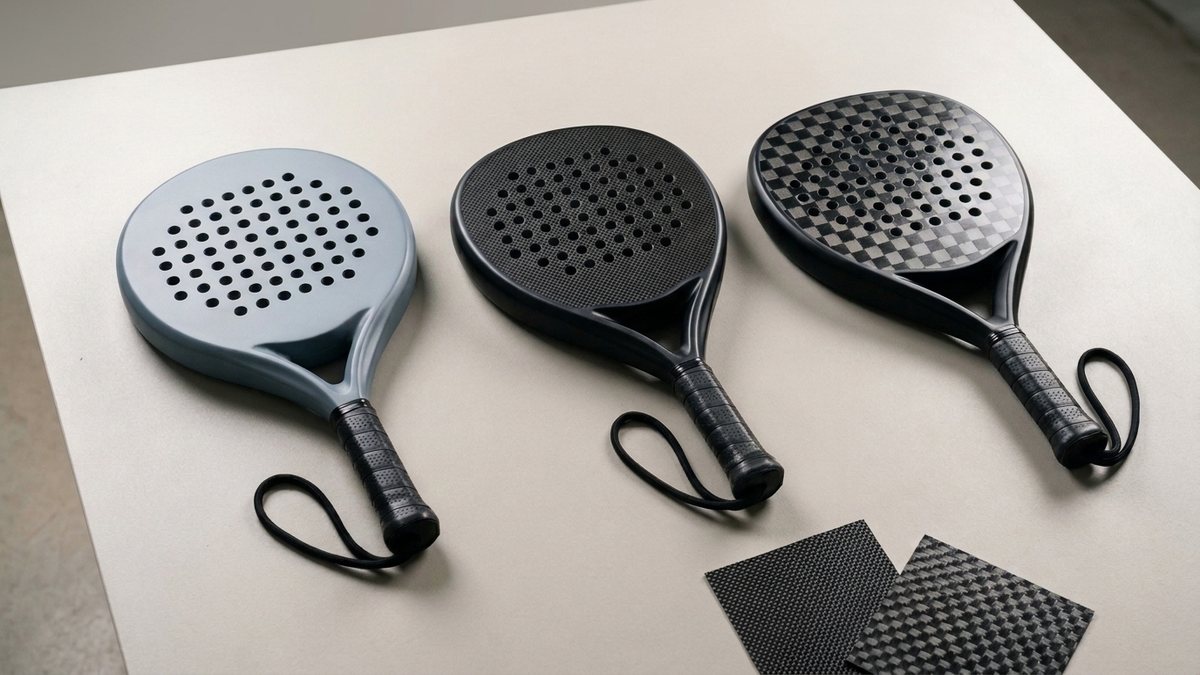
Direct Answer (TL;DR): Brands, distributors, and padel clubs can source custom OEM/ODM padel rackets directly from a China composite factory using existing open molds starting from 100 pieces per model for custom logo and full-surface artwork. Entry and club rental lines typically pair fiberglass faces with EVA Soft cores in a round mold, mid-tier all-round models use 3K or 12K carbon in a teardrop mold, and stiff power-oriented frames use 12K or 18K carbon in a teardrop or diamond mold. Always approve a physical sample for weight, balance point, hole-drilling alignment, and surface finish before bulk production.
European, Middle Eastern, Latin American, and Asian padel markets continue to expand rapidly, driving strong demand for brands and academies launching their own racket collections. When buyers search for companies that manufacture padel rackets in China and offer OEM/ODM services, the biggest gap is rarely finding a supplier willing to print a logo—it is defining a repeatable composite layup so every production batch plays identically to the approved sample.
In this factory-side guide, we break down how to specify face materials (fiberglass vs 3K, 12K, and 18K carbon), EVA core density, mold shapes, minimum order quantities, and pre-shipment quality control when working with a China carbon fiber padel racket manufacturer.
How Do Fiberglass, 3K, 12K, and 18K Carbon Padel Faces Compare for OEM Brands?
A padel racket's face layup controls ball output, vibration damping, touch, and cost structure. Unlike pickleball paddles—which use thin solid faces over a polymer honeycomb core—padel rackets combine a 38 mm perforated composite shell with an internal EVA foam core (see our full structural comparison in Padel vs Pickleball vs Beach Tennis Construction Guide).
| Face Material | Relative Stiffness & Feel | Ball Output & Sweet Spot | Best-Fit Player & Retail Tier | Typical OEM Pairing |
|---|---|---|---|---|
| Fiberglass | Flexible, forgiving, higher vibration comfort | High effortless rebound; generous sweet spot | Beginners, club rental fleets, coaching academies | Round mold + EVA Soft core |
| 3K Carbon | Balanced medium-firm response | Controlled rebound with crisp defensive touch | Intermediate club players, all-round retail SKUs | Round or teardrop mold + EVA Soft/Medium |
| 12K Carbon | Firm, direct energy transfer on fast swings | Strong attacking pace with structured control | Intermediate-to-advanced players, flagship brand lines | Teardrop or diamond mold + EVA Medium |
| 18K Carbon | High structural crispness & distinct wide-weave look | Precise power at high swing speed; tighter feel | Advanced / pro-style positioning, premium retail tier | Teardrop or diamond mold + EVA Medium/Hard |
Practical factory tip on 12K vs 18K: A higher "K" number refers to filament count per tow (12,000 vs 18,000 filaments per bundle), not automatically a stiffer racket on its own. Resin formulation, ply orientation, carbon-fiberglass hybrid sub-layers, and EVA foam hardness together determine final flex. That is why experienced OEM buyers always validate layup feel through a physical test sample rather than choosing purely by weave name.
How Should Brands Pair EVA Core Density With Round, Teardrop, and Diamond Molds?
Need a Carbon Fiber Badminton Racket Manufacturer?
Explore our T700/T800 and 40T high modulus racket series, or send your OEM specifications.
Most successful private-label padel brands launch a focused 3-SKU core lineup instead of ten overlapping frames:
- Round Mold (Control & Club Rental): Lower balance point (closer to the handle), widest sweet spot, and easy maneuverability at the net. Pair with fiberglass or 3K carbon and EVA Soft for beginners, junior clinics, and high-turnover club rental pools.
- Teardrop / Hybrid Mold (Best-Selling All-Round SKU): Mid balance point blending defensive control with overhead power. Pairing 3K or 12K carbon with EVA Soft-to-Medium foam makes teardrop models the highest-volume retail choice for most regional distributors.
- Diamond Mold (Attacking Power SKU): Higher head-heavy balance point with a higher sweet spot tailored to aggressive overhead smashes. Best paired with 12K or 18K carbon faces and medium-to-high density EVA for advanced players.
For spin enhancement, factories offer matte paint, glossy clear coat, quartz/sand grit rough coatings, or molded 3D geometric surface textures. If your line targets durable club rentals, matte or molded 3D textures generally resist cosmetic wear longer than heavy loose-grit coatings.
What MOQ, Mold Options, and Customization Scope Apply When Ordering From China?
Understanding the boundary between open-mold OEM and custom-mold ODM protects your launch budget:
- Standard Open-Mold OEM (From 100 pcs per model): Select from confirmed factory round, teardrop, or diamond molds and customize your face layup (fiberglass, 3K, 12K, or 18K carbon), EVA hardness, surface finish, full-face brand graphics, bridge/frame colors, grip wrap, wrist strap printing, and custom carry bag or retail sleeve. At 100 pieces per model, even a single padel club, academy, or emerging brand can launch a dedicated line.
- Custom Exclusive Mold ODM (Project-Quoted Tooling): If you require a proprietary bridge geometry, custom hole-drilling matrix, or unique frame profile, dedicated CNC aluminum mold tooling is quoted separately based on your 3D CAD drawings before sampling.
- Samples & Pre-Production Sign-Off: Order functional samples with your exact face material, core density, and artwork to verify balance, grip comfort, and finish before authorizing mass production.
What Factory Quality Control Checks Prevent Premature Cracking and Weight Drift?
Padel rackets endure repetitive impact near drilled holes and frame bridges. Before bulk shipment leaves our composite production facility, consistent batch QC should verify six measurable checkpoints against your signed golden sample:
- Weight Tolerance Control: Checking finished unstrung weight (typically 355–375 g depending on model spec) within the agreed batch tolerance band so players do not receive mismatched pairs.
- Balance Point Consistency: Measuring balance distance from the butt cap (mm) to confirm round, teardrop, or diamond swing characteristics stay consistent across the lot.
- Hole-Drilling & Edge Cleanliness: Inspecting every drilled perforation for clean carbon edges without delamination, micro-cracks, or jagged burrs that cause early face splitting.
- Frame & Bridge Structural Integrity: Visual and tap inspection along the tubular carbon frame and throat bridge where high-stress torsion occurs.
- Artwork, Coating & Roughness Uniformity: Verifying Pantone color match, decal registration, matte/gloss consistency, and grit/3D texture adhesion.
- Handle, Cap & Wrist Strap Assembly: Checking butt-cap alignment, overgrip wrap tightness, wrist-cord anchor strength, and protective export carton packing.
How to Prepare a Clear Padel OEM/ODM RFQ Brief
To receive an accurate factory quotation and sampling schedule on the first reply, include these seven items in your inquiry:
- Target models & shapes (e.g., 1 fiberglass round rental model + 1 12K teardrop + 1 18K diamond)
- Preferred face materials (fiberglass, 3K, 12K, 18K) and EVA feel (soft, medium, firm)
- Target weight range (g) and surface finish (matte, glossy, sand grit, or 3D texture)
- Order quantity per model (starting from 100 pcs on standard molds)
- Artwork status (ready AI/PDF vector files or need template dielines)
- Packaging preference (polybag, branded drawstring/zipper bag, or custom retail box)
- Destination country and target delivery window (note: designing to general tournament dimensions is distinct from formal federation approval; confirm any event-specific certification needs by project)
Frequently Asked Questions About China Padel Racket OEM/ODM
1. What is the minimum order quantity (MOQ) for custom padel rackets from China?
On confirmed standard factory molds, custom logo and full-surface artwork programs start from 100 pieces per model. This allows clubs, academies, and growing brands to launch multiple tiers (such as fiberglass entry rackets alongside 12K or 18K carbon models) without over-investing in inventory.
2. Should my brand choose 12K or 18K carbon for our flagship padel racket?
Both 12K and 18K carbon are widely used on mid-to-high-tier padel rackets. The final playing feel depends on the combination of carbon weave, resin system, internal fiberglass sub-layers, and EVA foam hardness. We recommend testing physical samples of both layups with your preferred EVA density before locking bulk production.
3. Can we order both fiberglass club rackets and carbon fiber retail rackets in the same shipment?
Yes. Many distributors and padel clubs combine a durable fiberglass + EVA Soft round model for coaching and rentals with 3K, 12K, or 18K carbon models for retail pro-shop sales, consolidating production QC and sea/air freight in one shipment.
4. Do we need to pay for a custom mold to start a private-label padel line?
No. Most emerging brands and clubs start on proven factory open molds (round, teardrop, or diamond) with zero mold tooling cost, customizing the face material, core density, surface texture, full graphics, grip, and packaging. Custom mold tooling is only required if you want proprietary frame or bridge geometry.
5. How do we confirm quality before mass production ships?
Every OEM order follows sample approval before bulk manufacturing. Once your team approves the physical sample's weight, balance, feel, and print colors, that signed sample serves as the reference standard for batch quality checks prior to shipment.
Ready to Develop Your Custom Padel Racket Line?
Share your target shapes (round, teardrop, diamond), face layups (fiberglass, 3K, 12K, 18K carbon), and estimated quantities per model. Our factory engineering team will send mold dielines, sampling options, and an itemized OEM/ODM quotation.
Request Padel OEM/ODM Quote → View Padel Racket Manufacturer Overview


